Why Enterprise AI Requires a Different Operating Model
AI transforms enterprises not by adding another tool, but by changing how the organization itself operates.
Walk into almost any large enterprise today and you will hear a familiar conversation.
One team is experimenting with a chatbot to answer employee questions. Another has deployed an AI assistant for software developers. Marketing is generating campaign content with generative AI. Operations is summarizing documents. Legal is reviewing contracts faster than ever before.
Taken individually, each initiative makes sense. Together, they create the impression that the enterprise is becoming AI-enabled.
But step back for a moment and ask a different question.
Has the way the organization actually operates changed?
In many cases, the answer is surprisingly little.
Employees may work faster. They may spend less time searching for information or writing reports. Meetings may begin with AI-generated summaries instead of handwritten notes. Yet the underlying operating model remains largely intact. Decisions still move through the same organizational structures. Knowledge remains fragmented across teams. Institutional expertise still resides with a handful of experienced individuals. AI has been added to the business, but it has not yet become part of the business itself.
The true promise of Enterprise AI isn't realized when employees use AI tools—it is realized when intelligence becomes an invisible part of how the enterprise itself operates. That is the difference between AI adoption and AI transformation.”
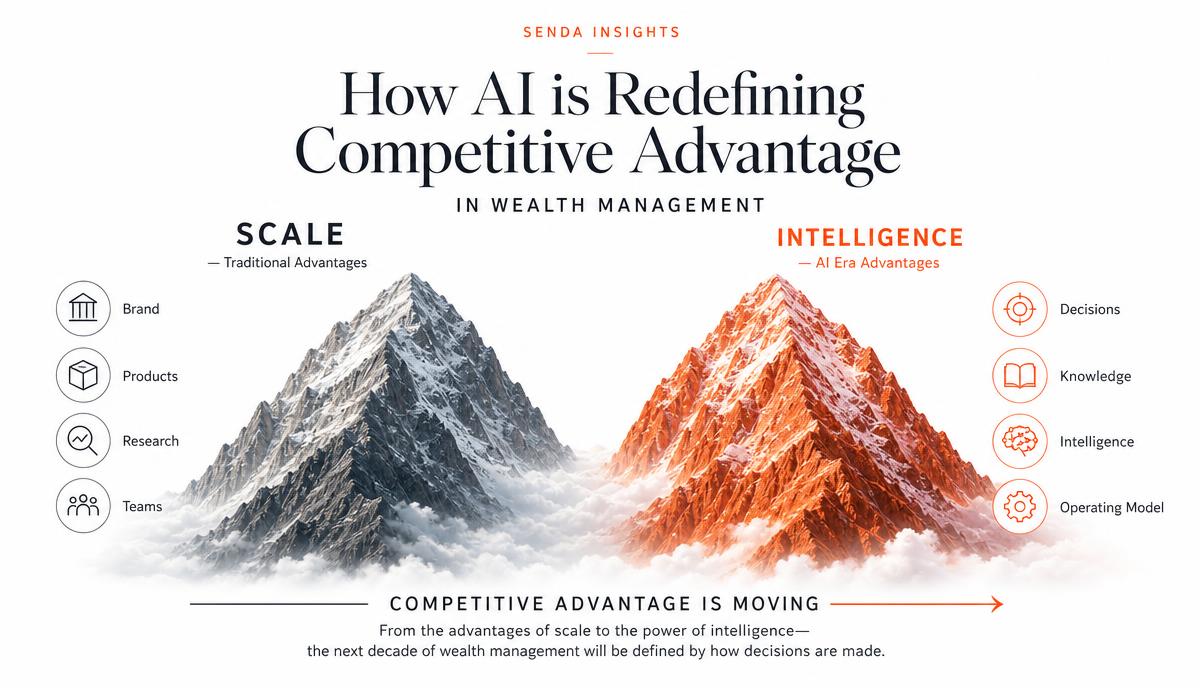
The enterprises that lead the AI era won't be distinguished by the sophistication of their models, but by the intelligence embedded within their operating model. Sustainable competitive advantage will come from organizational design—not technology alone.
This distinction may prove to be one of the defining questions of Enterprise AI.
For decades, organizations have evolved by embedding technology into the way they operate. Enterprise Resource Planning systems standardized financial processes. Customer Relationship Management platforms centralized customer information. Workflow systems digitized approvals. Cloud computing changed how infrastructure was provisioned. Each generation of technology eventually disappeared into the background, becoming part of the organization's operating fabric rather than a separate capability.
AI appears to be following a different path.
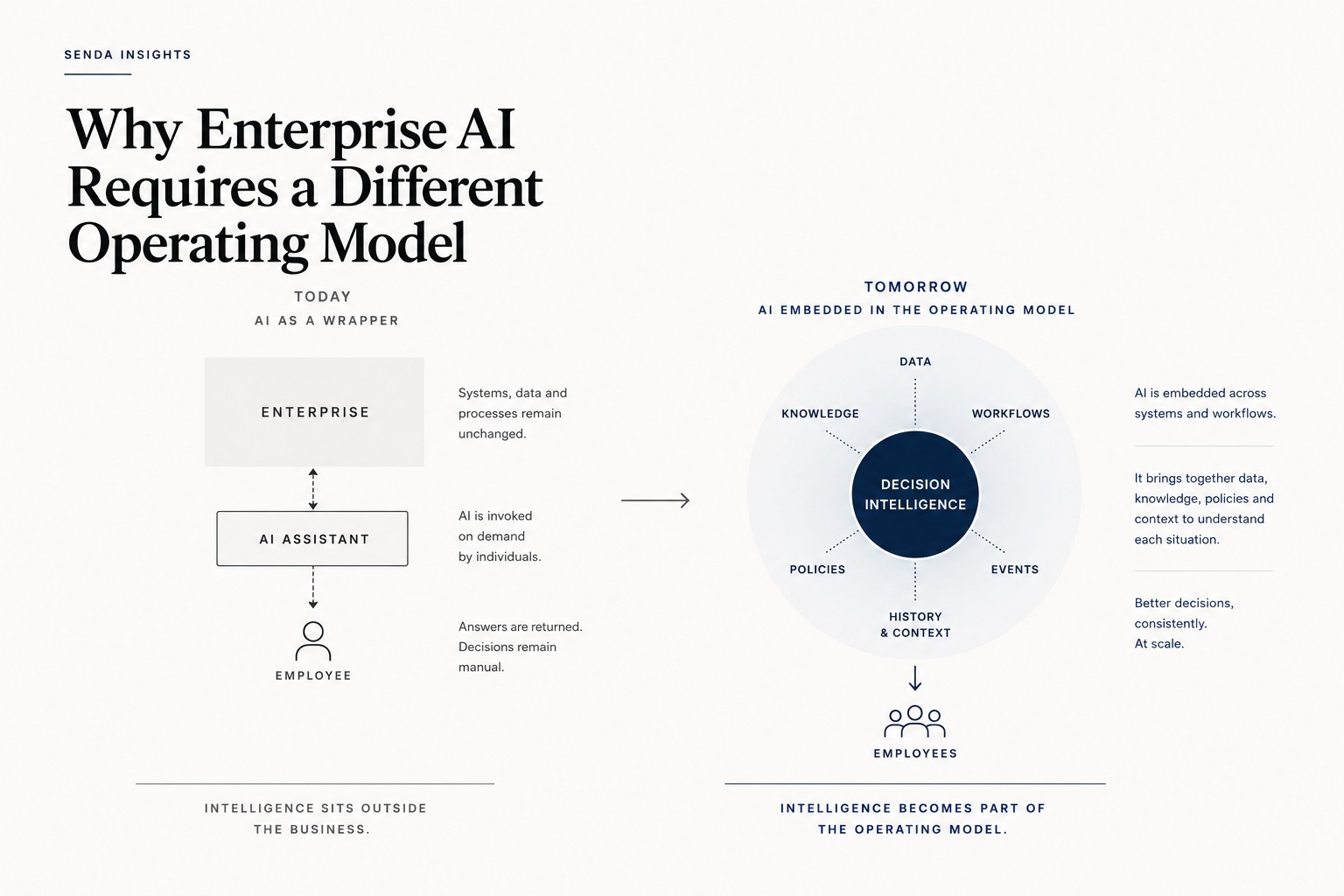
Today, much of Enterprise AI exists outside the operating model. Employees open another application, ask another question or invoke another assistant. Intelligence becomes something they consult rather than something the enterprise continuously applies.
That may improve productivity, but it does not fundamentally improve how organizations make decisions.
Consider how an experienced wealth manager prepares for an important client meeting.
The process rarely begins with a single question. Market events must be understood. Client objectives revisited. Regulatory requirements confirmed. Existing portfolios analyzed. Alternative strategies evaluated. Previous recommendations reviewed. Product suitability assessed. Risks identified. Compliance validated. Only then does the advisor decide what recommendation should be presented.
None of these steps exist in isolation. Each depends on the others. Each draws upon different forms of knowledge. Each contributes to the quality of the final decision.
Now imagine attempting to perform that entire process through a series of disconnected prompts.
Each interaction may be helpful. Each response may even be impressive. Yet the responsibility for connecting every piece of information, validating every assumption and maintaining consistency across the entire decision still rests with the individual.
The intelligence remains external to the operating model.
Organizations don't create competitive advantage by asking AI better questions. They create it by embedding intelligence into every workflow, every decision and every outcome—consistently, at enterprise scale.”
An AI-native enterprise approaches the problem differently.
Instead of asking employees to orchestrate intelligence manually, intelligence becomes embedded within the workflow itself. Every stage of a business process has access to relevant institutional knowledge, business policies, historical decisions, quantitative models, external events and organizational context. Recommendations are generated with reasoning rather than isolated answers. Compliance is evaluated as decisions evolve rather than after they are completed. Every interaction contributes to institutional learning instead of disappearing once the conversation ends.
The employee is no longer coordinating intelligence.
The enterprise is.
This is an important architectural distinction because organizations do not compete by asking better questions. They compete by making better decisions.
That is why the future of Enterprise AI is unlikely to be determined by whichever organization deploys the largest number of AI assistants. It will be determined by which organizations build operating models capable of continuously combining human expertise, organizational knowledge, deterministic business logic and AI reasoning into every significant decision.
As foundation models continue to improve, language capabilities will become increasingly accessible to everyone. That is the nature of infrastructure. Electricity, cloud computing and databases eventually became available to every enterprise. AI models are likely to follow a similar trajectory.
If every organization has access to comparable models, then competitive advantage must come from somewhere else.
It will come from the intelligence surrounding those models. The institutional knowledge accumulated over decades. The workflows refined through experience. The governance mechanisms that ensure consistency. The decision frameworks unique to each organization. The ability to learn from every interaction and continuously improve future decisions.
These assets cannot simply be downloaded from a model provider. They are built into the operating model itself.
The enterprises that lead the AI era won't be distinguished by the sophistication of their models, but by the intelligence embedded within their operating model. Sustainable competitive advantage will come from organizational design—not technology alone.”
This is why the next chapter of Enterprise AI may have less to do with chat interfaces and more to do with organizational design.
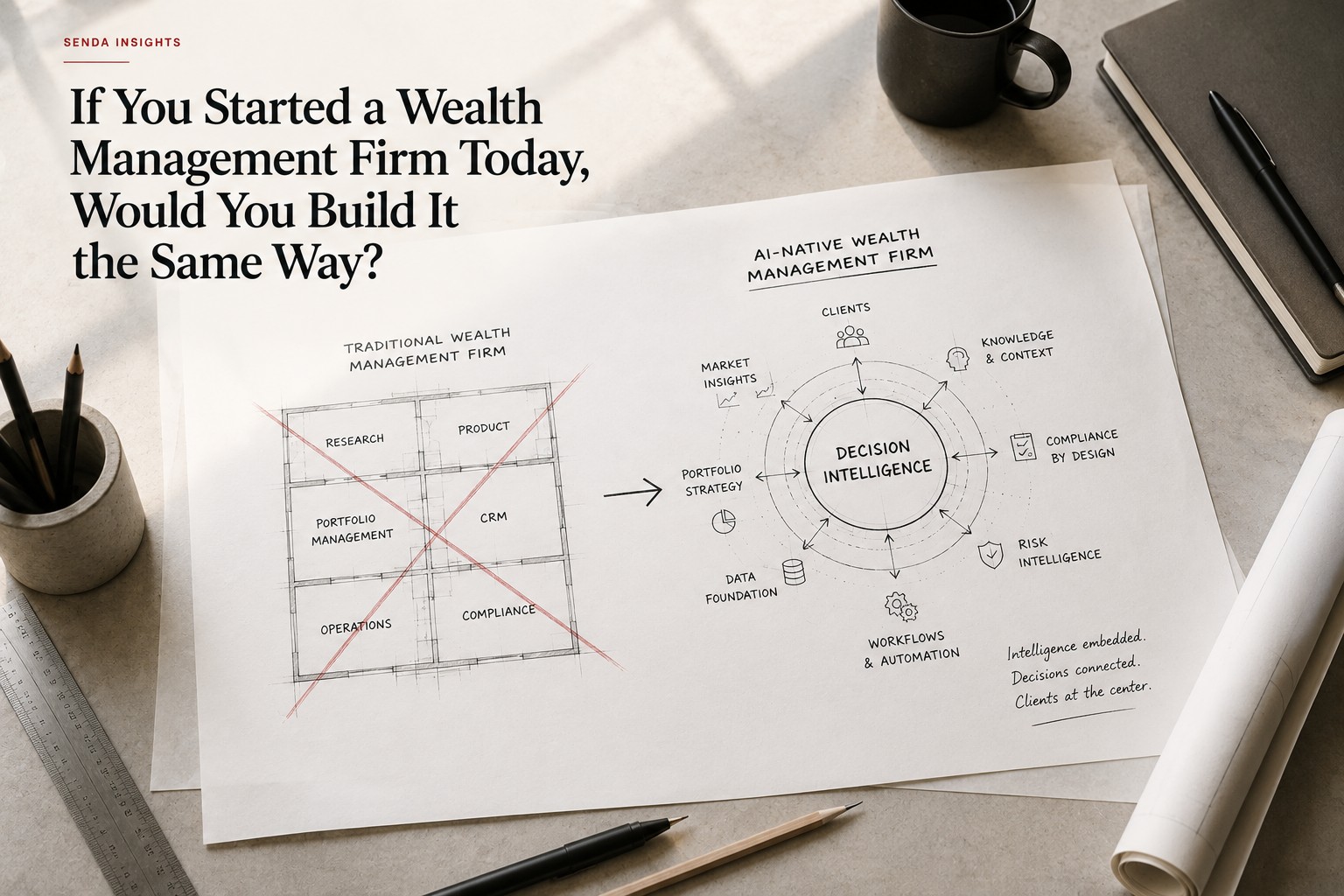
The most successful enterprises will not merely deploy AI alongside existing processes. They will redesign those processes so that intelligence becomes an invisible layer running through every important decision the organization makes.
In time, employees may stop thinking about when they are using AI altogether. Much as we no longer think about when we are using cloud computing or relational databases, intelligence will simply become part of how the enterprise operates.
That shift—from AI as an assistant to AI as an operating layer—may ultimately prove to be the real transformation. And it is likely to shape competitive advantage long after today's generation of chatbots and copilots has become commonplace.
Senda Editorial Team
Research & Insights