How AI is Redefining Competitive Advantage in Wealth Management
The firms that lead the next decade may not be those with the greatest scale, but those that embed intelligence into every decision.
Imagine launching a wealth management firm today.
Not twenty years ago, when success depended on hiring experienced advisors, building trusted client relationships and patiently growing assets under management. Imagine starting with a blank sheet of paper today.
Your first strategic decision probably wouldn't be which CRM to buy. It wouldn't even be which portfolio management system to implement.
Instead, you might ask a very different question.
If Artificial Intelligence could participate in every important decision my firm makes, how would I design the business differently?
Just a few years ago, that question would have sounded theoretical. Today, it feels increasingly practical.
Around the world, a new generation of wealth management firms is beginning to emerge. Some are backed by significant institutional capital. Others are being founded by experienced industry leaders who understand both the strengths and frustrations of the traditional operating model. What they share is a common opportunity: they can rethink how wealth management operates in an era where intelligence is no longer limited to people alone.
At the same time, established firms face a different challenge. They have spent decades building trust, refining investment processes and creating operating models that have served clients exceptionally well. Their question isn't how to build an AI-native firm from scratch. It's how to evolve an existing organisation without disrupting the consistency and confidence their clients expect.
These may sound like different problems.
In reality, they're both responding to the same shift.
Artificial Intelligence is not simply another technology upgrade. It has the potential to change the way decisions are made across an enterprise, and that may ultimately redefine what creates competitive advantage in wealth management.
The next competitive advantage in wealth management will not come from having more technology—it will come from embedding intelligence into every decision the enterprise makes.”
For decades, scale has been one of the industry's greatest strengths.
Larger firms could invest in research teams, investment committees, compliance specialists, technology departments and operational processes that smaller firms simply couldn't afford. Every investment recommendation benefited from layers of institutional expertise accumulated over many years. Scale wasn't just about managing more assets—it was about building a better decision-making engine.
Smaller firms often compensated with agility and stronger personal relationships, but they rarely had access to the same depth of institutional capability. If an advisor wanted to prepare for a client review, they frequently had to pull together information from multiple systems, coordinate with different teams and manually validate recommendations before they ever met the client.
That operating model has remained largely unchanged for years.
AI begins to challenge that assumption.
Much of today's conversation focuses on productivity. We ask how many hours AI can save, which tasks it can automate and whether it can reduce operational costs. Those are important questions, but they may not be the most interesting ones.
The more significant question is this:
What happens when institutional-quality intelligence becomes available to every advisor, every day, at every decision point?
Imagine preparing for a quarterly client review.
Before the advisor opens the client's portfolio, an intelligent system has already analysed market movements, identified allocation drift, reviewed investment policy constraints, highlighted tax implications, evaluated alternative products and prepared a set of recommendations for consideration. It hasn't replaced the advisor, nor should it. The relationship remains deeply human. Judgement remains with the advisor. Accountability remains with the firm.
AI doesn't replace the advisor—it transforms the quality of every decision leading up to the client conversation. Human judgement remains the differentiator; intelligence simply makes it stronger.”
But the quality of preparation changes dramatically.
Instead of spending valuable time gathering information, advisors spend more time interpreting it, discussing it with clients and making better decisions.
That distinction matters.
The firms that gain the greatest advantage from AI may not be the ones that automate the most work. They may be the ones that consistently make better decisions because intelligence is embedded into the way the organisation operates.
This is where the conversation becomes particularly interesting.
If intelligence becomes widely accessible, some of the traditional advantages of scale begin to change. A boutique wealth manager serving a few hundred families may soon have access to analytical capabilities that once required dedicated research teams. Proposal preparation, portfolio analysis, policy validation, risk identification and knowledge retrieval can increasingly be supported by intelligent systems operating alongside advisors.
That doesn't mean large firms lose their advantage. Far from it. Brand, trust, investment expertise and client relationships remain incredibly difficult to replicate.
What changes is the source of differentiation.
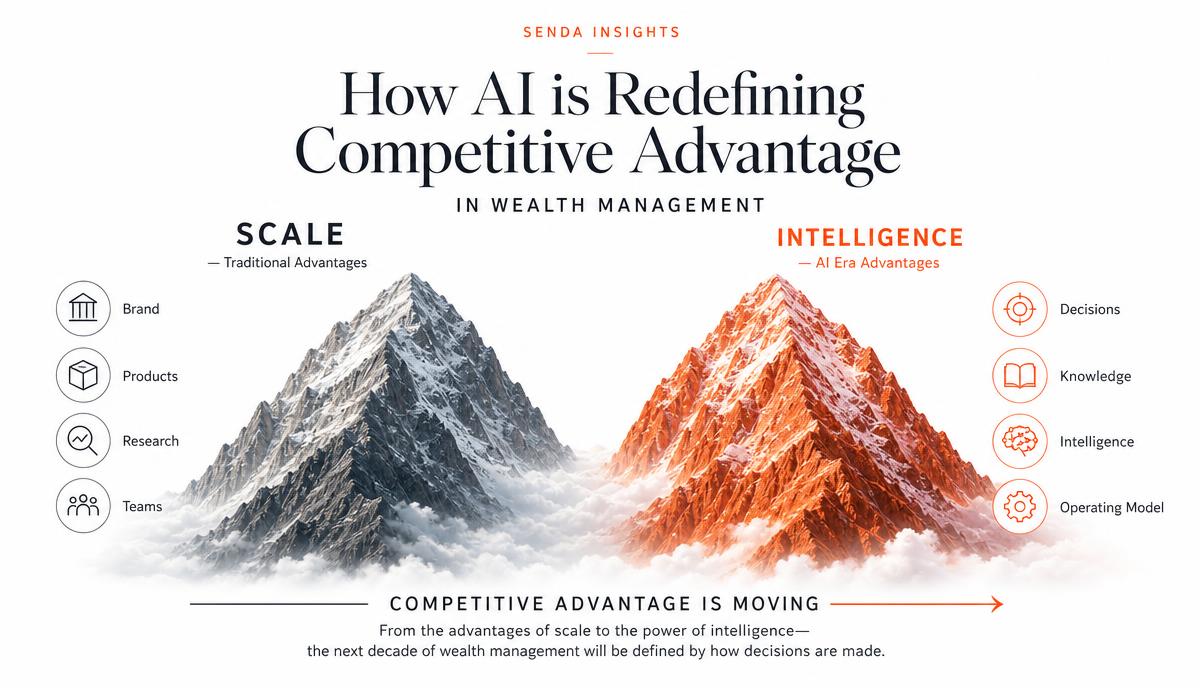
Historically, firms competed on products, people and scale. In the years ahead, they may increasingly compete on the quality of intelligence embedded within their operating models.
That is a fundamentally different way of thinking about competitive advantage.
The winners won't necessarily be the firms with the most AI tools. Nor will they be the firms that deploy chatbots across every department. Those technologies will quickly become commonplace.
The firms that stand out will be those that redesign how decisions are created, reviewed, governed and continuously improved across the enterprise. They will combine human expertise with intelligent systems in ways that make every client interaction more informed, every recommendation more consistent and every operational process more effective.
Tomorrow's market leaders won't be defined by the number of AI tools they deploy, but by how intelligently their entire organization thinks, decides and continuously improves.”
Every major technology wave has reshaped wealth management in some way. Digitisation replaced paper. The cloud transformed infrastructure. Mobile changed how advisors and clients interacted.
Artificial Intelligence is different because it changes how organisations think.
That may ultimately become its greatest contribution to the industry.
For wealth management firms, the race ahead is no longer simply to become more digital.
It is to become more intelligent.
And for many firms, that journey is only just beginning.
Senda Editorial Team
Research & Insights