If You Started a Wealth Management Firm Today, Would You Build It the Same Way?
The next generation of wealth managers will be designed around intelligence rather than traditional technology.
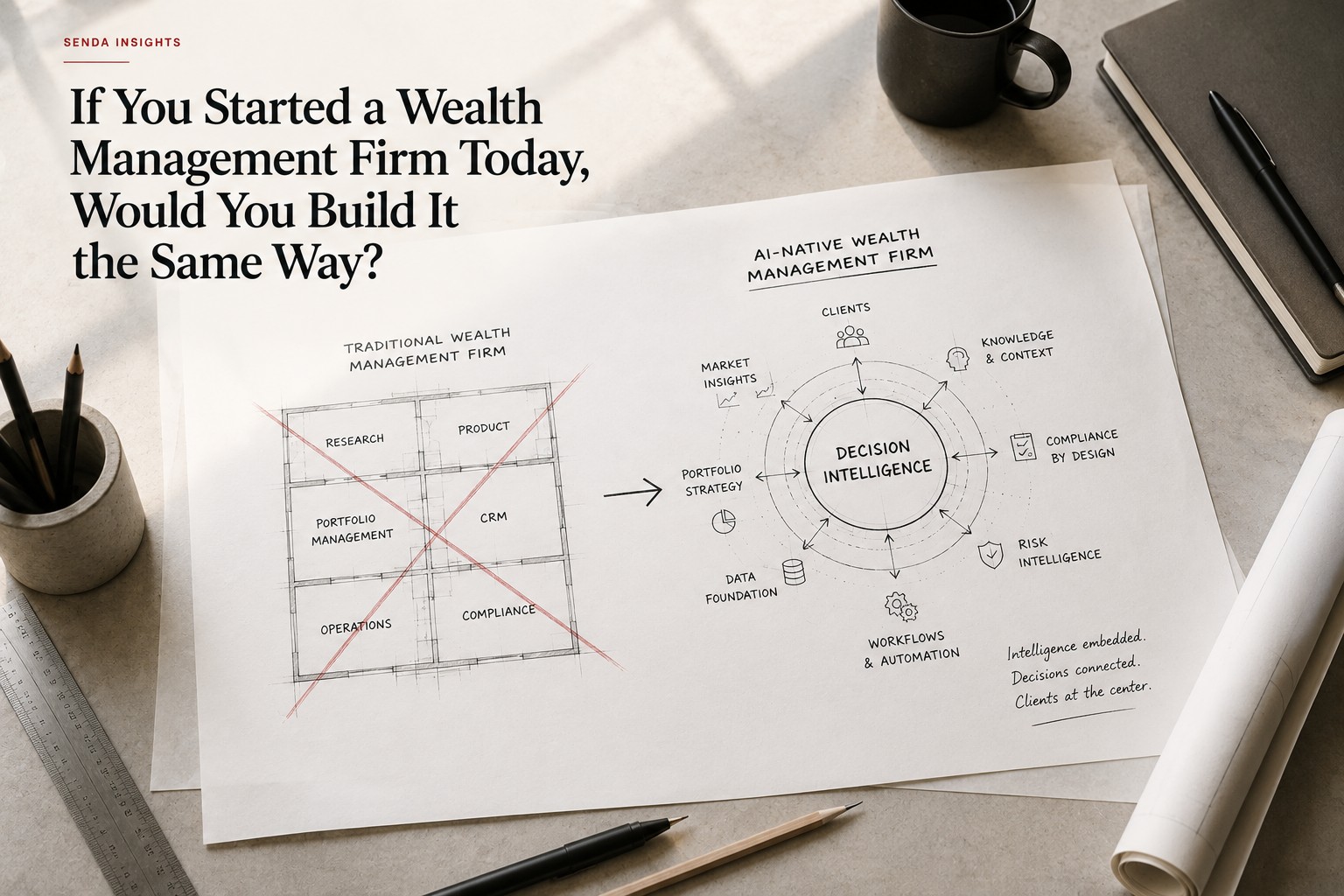
Imagine that you were asked to build a wealth management firm from the ground up.
There are no legacy systems to preserve. No established reporting lines. No inherited workflows. No requirement to reproduce the way the industry has operated for the past thirty years.
You have experienced advisors, access to modern investment products and the ability to design the technology and operating model from a blank sheet of paper.
What would you build?
It is tempting to begin with the familiar answers. A portfolio management platform. A CRM system. A client portal. Research tools. Reporting software. Digital onboarding. Perhaps a series of AI assistants layered over each of them.
That would produce a modern wealth management firm.
But would it produce a firm designed for the age of AI?
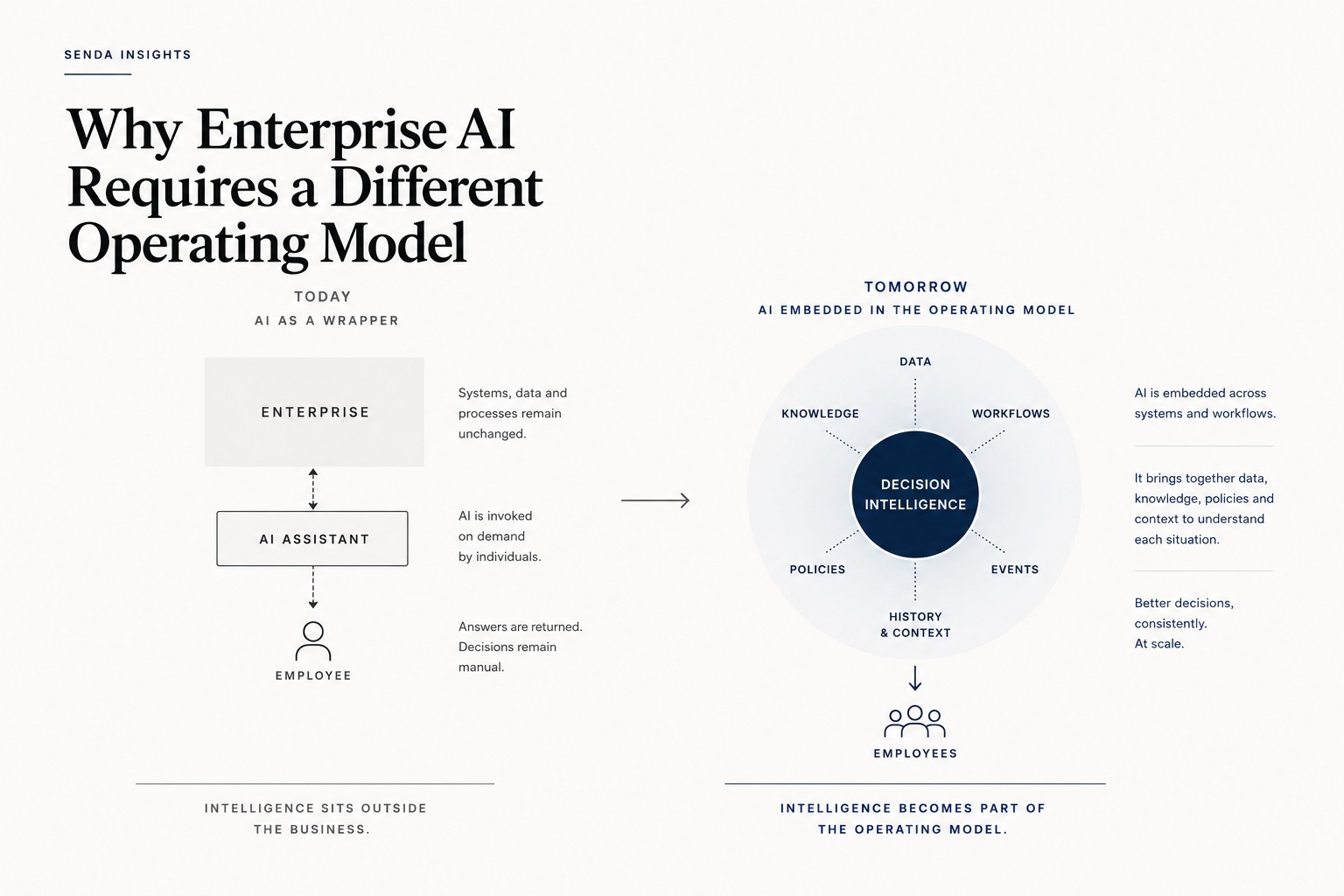
The distinction matters because most established institutions are approaching AI from the outside in. They begin with the organization they already have and ask where AI can make it more efficient.
Can it summarize client meetings? Can it draft investment proposals? Can it search research more quickly? Can it answer advisor questions? Can it reduce the time spent reviewing documents?
These are useful questions. They can produce real productivity gains. But they also assume that the existing operating model is fundamentally correct and simply needs better tools.
A firm designed today might begin with a different question.
The defining question is no longer which technologies a wealth management firm should deploy. It is how intelligence should flow through every decision the organization makes.”
What are the important decisions the organization must make, and how should intelligence flow through them?
Consider something as ordinary as preparing for a client review.
To the client, the meeting may appear to be a conversation between two people. Behind it sits a surprisingly complex process.
The advisor must understand what has changed in the client's life, whether the portfolio remains aligned with its objectives, how markets have affected existing positions, whether any risks require attention and what opportunities may now be relevant.
Research must be interpreted. Product suitability must be assessed. Tax and regulatory constraints may need to be considered. Previous conversations must be remembered. Recommendations must be explained clearly and consistently.
In most firms, much of this work is coordinated by the advisor. Information is collected from several systems. Reports are requested. Emails are searched. Specialists are consulted. Assumptions are reconciled. The quality of the final recommendation depends not only on the institution's capabilities, but also on how effectively one person brings those capabilities together.
The firm may possess deep intelligence, yet much of that intelligence remains fragmented. Research lives in one place. Client information lives in another. Product expertise sits with specialists. Historical decisions are buried in documents and email. Compliance is often applied near the end of the process.
The advisor becomes the integration layer.
Now imagine designing the same experience without accepting that assumption.
Before the meeting begins, the client's objectives, constraints and previous decisions are already understood. Market events have been connected to the relevant holdings. Material changes in risk have been identified. Alternative actions have been evaluated. Product suitability has been considered. Policies and compliance requirements have been applied as the recommendation develops, rather than checked after it is complete.
The advisor does not begin by assembling the institution's intelligence. The advisor begins by applying judgment to it.
The future advisor won't spend more time searching for information—they'll spend more time applying judgment. Intelligence becomes the starting point, while human expertise becomes the differentiator.”
That may sound like a technology improvement, but it is actually an operating-model change.
The work is no longer organized only around functions and systems. It is organized around decisions.
This has consequences across the firm. Research is no longer simply published and distributed. It becomes available at the moment a decision requires it. Compliance is no longer a separate checkpoint at the end of a process. It becomes part of the process itself. Operations does not merely process instructions. It monitors intelligent workflows, exceptions and outcomes. Client information is not simply stored. It becomes context that shapes every future action.
The boundaries between functions begin to change because intelligence can move across them continuously.
This is where an AI-native firm may look very different from a digitized traditional firm.
The traditional firm scales by adding capacity. More clients usually require more advisors, more analysts, more operations professionals and more layers of coordination. As the organization grows, it accumulates expertise, but that expertise often remains concentrated in people and departments.
An AI-native firm has the opportunity to scale knowledge differently. Every client interaction can improve future interactions. Every recommendation can become part of institutional memory. Every exception can refine a workflow. Every market event can strengthen the organization's understanding of how external changes affect individual clients.
The firm does not merely employ intelligent people. It becomes capable of retaining and applying their intelligence.
This may be more consequential than automation. Automation reduces effort. It allows an existing activity to be completed faster or with fewer people. Embedded intelligence changes the quality and consistency of the activity itself.
It can make expertise available beyond the small group of people who originally developed it. It can reduce the variation between the firm's strongest and weakest decisions. It can help the organization respond to change without waiting for knowledge to travel through meetings, reports and hierarchy.
It also changes the economics of scale.
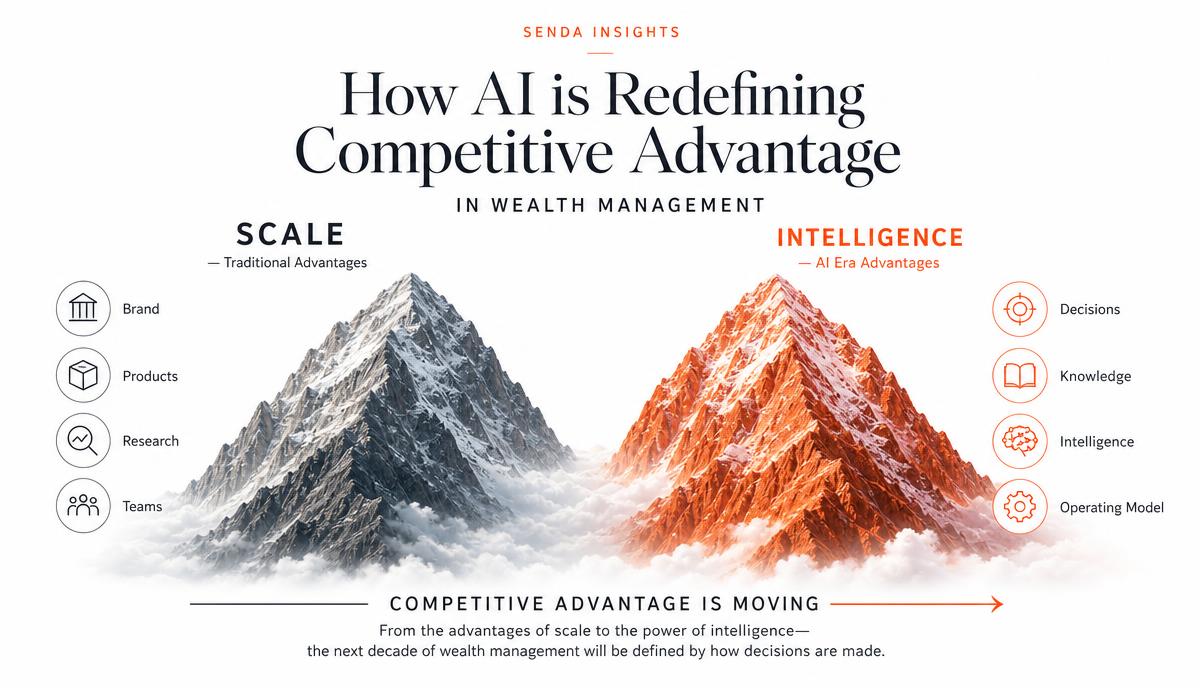
Large wealth managers have traditionally benefited from capabilities that smaller firms struggle to reproduce: deep research teams, broad product expertise, specialized risk functions and sophisticated operating infrastructure. Those advantages will not disappear. But AI may make some forms of institutional capability less dependent on institutional size.
A smaller firm that embeds intelligence throughout its operating model may be able to deliver consistency, responsiveness and personalization that previously required a much larger organization. A large firm, meanwhile, may discover that its scale becomes an advantage only when its knowledge can move effectively across the enterprise.
The important divide may therefore be less about large firms and small firms. It may be between firms that use AI to improve individual tasks and firms that use it to redesign how the organization thinks.
The first group will become more productive. The second may become structurally different.
Established institutions are not prevented from making this transition. In some respects, they possess the ingredients that matter most: proprietary knowledge, trusted relationships, historical data, experienced people and well-developed governance.
The firms that redefine wealth management won't simply automate existing processes. They will redesign the enterprise so intelligence is embedded within every client interaction, every workflow and every decision.”
But they also face a harder design problem. A new firm can begin with decisions and build the organization around them. An established firm must often work backwards through systems, departments and processes that were created for another era.
That may be why the most revealing question is not where AI can be added to a wealth management firm. It is what kind of wealth management firm you would build if AI had always been available.
The answer is unlikely to be today's institution with a chatbot attached.
It may be an organization in which intelligence is no longer something advisors search for, departments produce or specialists possess. It becomes part of how the firm operates.
And once that happens, the future wealth manager may not simply be a more digital version of the one we know today. It may be a different kind of institution altogether.
Senda Editorial Team
Research & Insights