What Is Capital Really Betting On in Wealth Management?
Capital is flowing into a new generation of wealth businesses while established firms are measured on traditional value. The more useful question is what investors are signalling about the operating model they expect to win.
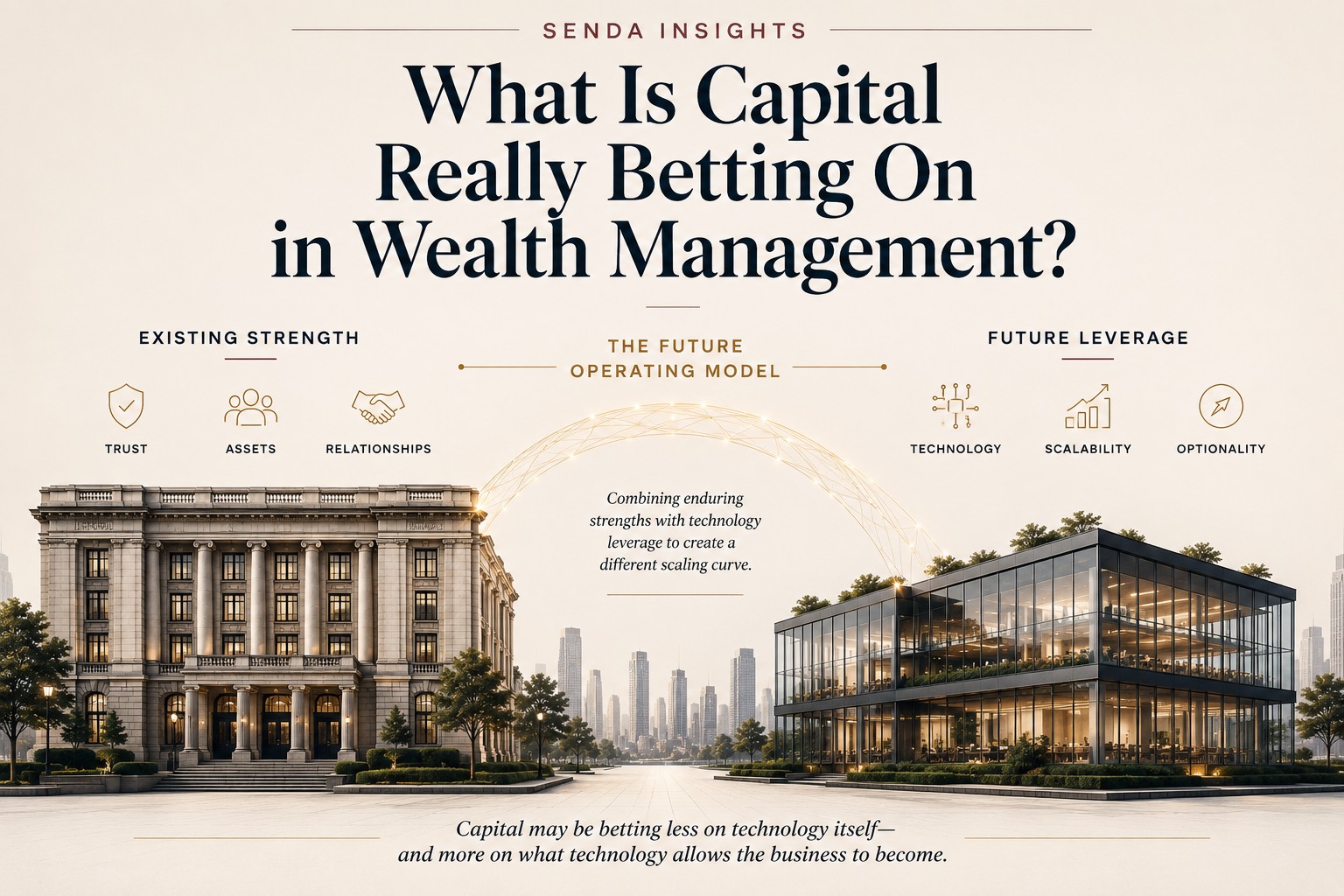
Capital is flowing into a new generation of wealth businesses at the same time that established firms continue to be assessed against more traditional measures of value. Rather than debating individual valuations, the more useful question for wealth-management leaders may be what investors are signalling about the operating model they expect to succeed in the future.
Something interesting is happening in wealth management. The industry itself has rarely looked more attractive. Private wealth continues to expand, entrepreneurship is creating new pools of investable assets, client expectations are rising, and the range of investment products available to affluent families is becoming increasingly sophisticated. At the same time, technology—and increasingly AI—is creating the possibility of serving those clients through operating models that would have been difficult to imagine only a few years ago.
Capital has noticed. Across India and other major markets, a new generation of wealth and wealth-technology businesses has attracted significant investor interest. Some have already built meaningful businesses; others are being funded substantially on the opportunity ahead of them. Established wealth managers, meanwhile, tend to encounter a different investment lens. Their businesses are evaluated through assets under management, revenues, profitability, client retention, advisor productivity, margins and the durability of their franchise.
There is nothing inherently inconsistent about these approaches. The businesses may be at different stages, carry different risks and attract different forms of capital. But the contrast raises a more useful question than whether any particular company is correctly valued:
what is capital actually betting on when it invests in the next generation of wealth management?”
The answer may tell the industry something important about how investors expect its economics to change.
Two Different Ways of Underwriting the Future
An established wealth manager presents investors with something enormously valuable: evidence. There are clients, assets, revenues and, frequently, profits. There may be years or decades of operating history. Investors can examine margins, retention, advisor productivity, client concentration and growth, and make judgments about the durability of the franchise and its future cash flows.
A younger technology-led wealth business can present a different proposition. Its current economics may tell only part of the story investors are being asked to underwrite. The investment case may depend more heavily on future growth, technology leverage, new distribution models, lower marginal costs, operating leverage and the possibility of serving significantly more clients and assets without a corresponding increase in organizational complexity.
In one case, capital can place considerable weight on the durability of an existing franchise. In the other, it may place greater weight on the optionality of a future operating model. Neither approach is inherently superior. They simply reflect different ways of underwriting future value.
The more interesting issue for the industry is what characteristics investors appear increasingly willing to fund. Technology is clearly one of them, but technology alone is an incomplete explanation. Almost every serious wealth manager today uses sophisticated technology. The distinction increasingly lies in what that technology is expected to do to the economics of the business.
From Digitization to Operating Leverage
Technology has influenced financial-services economics for decades. Wealth managers have invested substantially in CRM systems, portfolio-management platforms, digital onboarding, reporting, workflow applications and client portals. These systems have improved efficiency, increased transparency and transformed the client experience.
Much of this technology, however, has been designed to make the existing wealth-management operating model work better. A better CRM makes relationship managers more effective. A portfolio-management platform creates a stronger system of record. Digital onboarding reduces friction. Automated reporting saves operational effort. These are important improvements, but the fundamental relationship between growth and organizational capacity often remains largely intact.
Wealth management is, after all, an intelligence-intensive business. Research must be consumed, products evaluated, portfolios monitored, client circumstances understood, opportunities and risks identified, recommendations developed and decisions documented and communicated. Historically, much of this work has depended on highly skilled human capacity. As a business grows, organizational complexity therefore tends to grow with it: more clients and assets eventually require more relationship managers, analysts, investment specialists, operations personnel and supporting infrastructure.
AI creates the possibility—not the certainty—of changing that relationship. Institutional knowledge can increasingly be made available on demand. Portfolios can be monitored continuously rather than periodically. Research can be synthesized rapidly. Large product universes can be evaluated using consistent methodologies. Client information can be analysed across multiple systems, while recommendations and alternatives can be prepared far more quickly.
The significance is not simply that individual employees become more productive.
Technology may begin to change the relationship between growth and organizational complexity.”
That is a much larger economic proposition, and potentially a much more important reason for investor interest.
AI and a Different Scaling Curve
Consider the capacity of a relationship manager. It is constrained not only by the number of clients with whom an advisor can maintain meaningful relationships, but by everything surrounding those relationships: preparing for meetings, understanding portfolios, identifying issues, coordinating with investment teams, evaluating products, preparing proposals, documenting recommendations and producing client communications.
Much of that work requires intelligence rather than merely administration. If AI can perform meaningful portions of it—within appropriate institutional policies, governance and human oversight—an advisor may be able to serve more relationships without compromising the quality of advice. Analysts can spend less time assembling information and more time applying judgment. Investment expertise can become available more broadly across the organization rather than being constrained by the availability of individual specialists. Routine monitoring can become continuous rather than batch-driven.
None of this eliminates the importance of people. In a relationship-driven industry such as wealth management, human judgment, empathy and trust may become more valuable as machines absorb more of the analytical and operational work surrounding them. But the economic implication is significant:
Clients, assets and revenues could potentially grow faster than the human infrastructure required to support them.”
For investors, that possibility changes what can be underwritten. A wealth business that can materially alter the relationship between growth and human capacity has a different potential scaling curve from one in which organizational complexity continues to rise broadly alongside assets and clients.
This does not mean every technology-led wealth business will achieve such economics. Nor does the presence of AI automatically create operating leverage. Technology still has to be embedded into workflows, connected to institutional data and knowledge, governed appropriately and translated into measurable operating outcomes. But capital does not need certainty about the destination to assign value to the possibility of reaching it.
Technology Is Not the Same as Technology Leverage
This is why the distinction between “traditional” and “technology-enabled” wealth managers is becoming less useful. Almost every established institution is technology-enabled. The more consequential distinction may increasingly be between
technology that digitizes and improves an existing operating model and technology that changes the economics of the operating model itself.
A new client portal may materially improve experience without changing the economics of servicing that client. A better CRM can improve advisor productivity without fundamentally changing how institutional intelligence is produced. A portfolio-management platform can create an excellent system of record while leaving many of the decisions around that data dependent on manual processes.
The next generation of technology potentially operates at another layer. By connecting data, institutional knowledge, policies, analytical models, workflows and decisions, technology can begin to affect how intelligence itself is produced and distributed through an organization. AI amplifies this because tasks previously constrained by human analytical capacity can increasingly be executed continuously and at machine scale.
That is where technology begins to create operating leverage rather than simply operational efficiency. Investors may therefore be less interested in technology as an asset in itself than in what technology allows the business eventually to become.
The Incumbent Advantage
For established wealth managers, this should be an encouraging observation. They already possess many of the assets that new entrants may spend years and considerable amounts of capital trying to build: trusted client relationships, assets, distribution, experienced advisors, investment expertise, institutional knowledge, established brands and, in many cases, profitable businesses.
These advantages should not be underestimated. Technology does not manufacture trust overnight, and AI does not eliminate the difficulty of acquiring and retaining wealthy clients. Nor does a technology-native architecture automatically create sound investment judgment or deep client relationships.
The strategic opportunity for an established institution is therefore not to become a technology startup. It is to ask whether technology and AI can make the advantages it already possesses substantially more scalable.
An investment team's expertise, for example, can potentially influence far more decisions without requiring the team to expand proportionately. Institutional knowledge can become available to every advisor when it is needed. Client portfolios can be monitored continuously rather than waiting for periodic review cycles. Relationship managers can devote more of their capacity to judgment and relationships rather than information assembly. And the institution may be able to add clients and assets without adding organizational complexity at the same rate.
Seen this way, technology transformation is not primarily a technology agenda. It becomes a question of the future economic architecture of the wealth manager.
What the Flow of Capital Is Signalling
It is easy to look at capital flowing into new-generation businesses and turn the discussion into whether particular valuations are justified. That may be the least useful interpretation of what is happening. Some technology-led wealth businesses will fulfil today's expectations and others will not. Some established institutions will transform rapidly, while others may determine that their existing operating model remains entirely appropriate for the clients they serve.
What matters for boards and CEOs is the signal contained in where capital is willing to take risk. Investors appear increasingly interested in scalability, technology leverage, operating efficiency, future optionality and the possibility of growing without increasing organizational complexity at the same rate. AI is making some of those possibilities considerably more credible than they were even a few years ago.
The strategic question is therefore not whether an established wealth manager should try to resemble a new entrant, nor whether investors are right to favour one model over another. It is what characteristics of tomorrow's wealth-management business capital is beginning to reward today.
Established wealth managers may be unusually well positioned to respond. They already possess many of the industry's hardest assets to create. If those assets can be combined with technology that changes how intelligence is produced, how decisions are executed and how organizational capacity scales, the resulting institution could have advantages that neither the traditional nor the new-generation model possesses independently.
Capital may be betting on a different future for wealth management. The more important question for established institutions is not whether that bet is right, but how much of that future they can create from the position of strength they already have.
Senda Editorial Team
Research & Insights