The Growing Gap Between AI Strategy and AI Reality
AI may now be one of the most discussed strategic priorities in wealth management. Yet recognizing that AI will matter and making the decisions required to act on that belief are very different things.
AI may now be one of the most discussed strategic priorities in wealth management. Yet recognizing that AI will matter and making the decisions required to act on that belief are very different things. Some institutions are investing and beginning to change how they operate. Others are experimenting at the edges, while many continue to wait for better models, lower costs, clearer regulation or greater certainty. The next competitive divide may emerge not from who understands AI, but from who is willing to turn strategic conviction into operating reality.
Artificial intelligence no longer suffers from a lack of executive attention. Across wealth management, boards and leadership teams are discussing what AI could mean for advice, client engagement, investment processes, advisor productivity and the economics of operating the institution. There is still considerable uncertainty about technology, timing and implementation, but increasingly the debate is not about whether AI will matter. It is about what to do about it.
That distinction is becoming important. An institution can believe deeply that AI will reshape its industry and still postpone the decisions required to prepare for it. Budgets are already committed. Regulatory and cybersecurity investments cannot be deferred. Core platforms must be maintained. Existing transformation programs need to be completed. Meanwhile, AI technology continues to change so rapidly that waiting another six months can appear entirely rational. Six months later, many of the same arguments still apply.
The strategic consensus around AI may be arriving faster than the willingness to make decisions about it.”
This is creating a growing gap between AI strategy and AI reality. It is not simply a question of how much institutions are spending. It is about whether they are making choices at all: which capabilities matter, which workflows should change, what should be built or bought, what infrastructure is required, and where AI deserves to compete with existing priorities for capital and management attention.
There Will Always Be a Reason to Wait
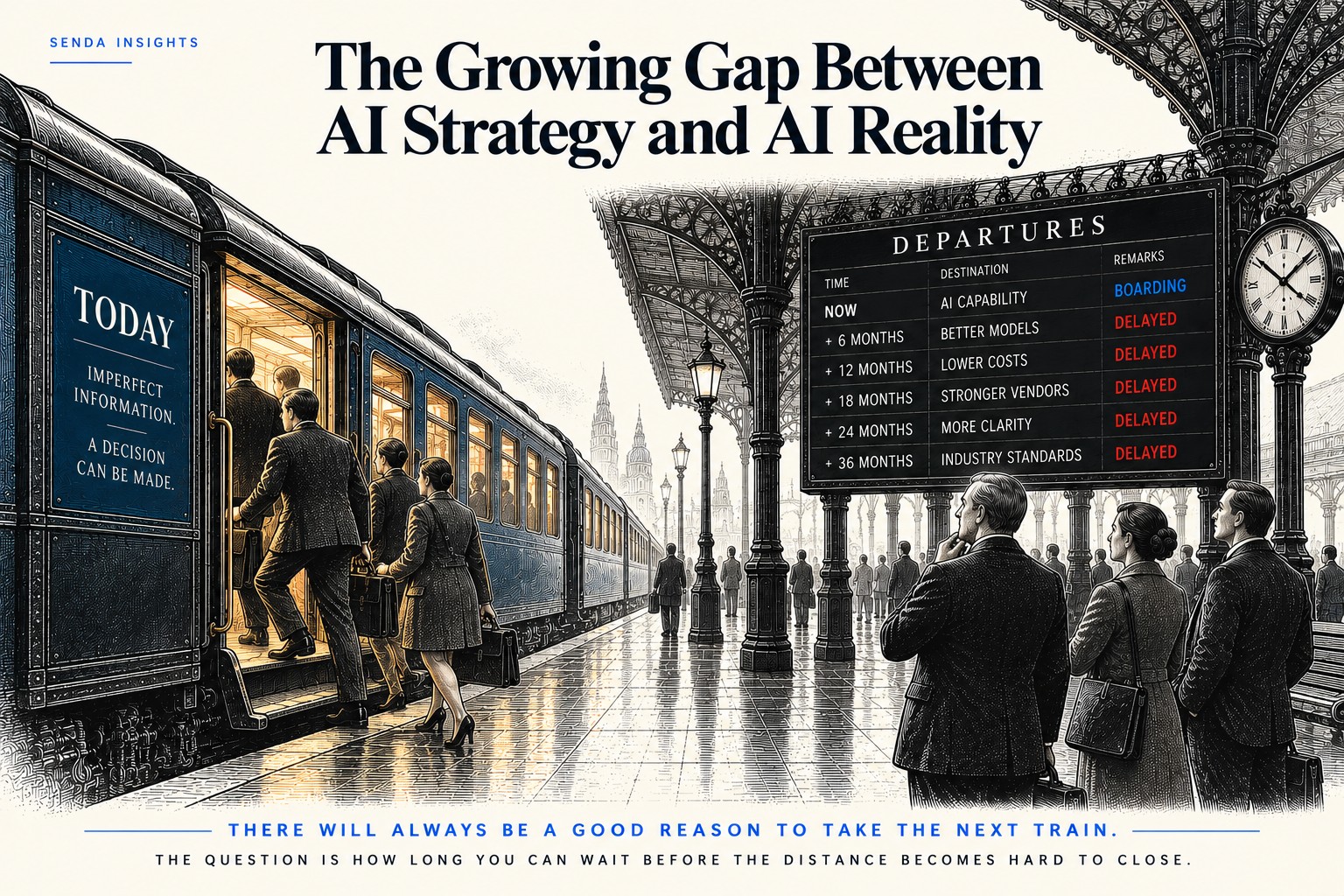
Few technologies have given executives as many reasonable arguments for postponing a decision as AI. Models are improving rapidly. Costs are falling. Open-source alternatives are becoming more capable. Existing enterprise-software providers are adding AI to their products. Agent architectures continue to evolve. Regulatory expectations are developing. A capability that requires significant investment today may become easier or cheaper tomorrow.
For a wealth-management CEO facing a long list of immediate business priorities, waiting can therefore look less like indecision and more like prudence. Why make a significant commitment today if the technology may be materially better next year? Why build something if the CRM or portfolio platform may soon provide it? Why choose an architecture before the market settles? Why commit significant capital before competitors have demonstrated the economics?
Individually, each question is sensible. Collectively, they can create a state of permanent preparation in which the institution continuously studies AI while postponing the decisions required to change how it operates.
The difficulty is that there may never be a moment when the uncertainty disappears. Models will continue improving. New vendors will emerge. Existing applications will become more intelligent. Costs will continue falling. Regulation will evolve. There will almost always be another reason to wait for greater clarity.
The next train may always look better than the one leaving today.
At some point, waiting for uncertainty to disappear becomes a strategy in itself.
Business as Usual Has a Structural Advantage
The decision is made harder by the way capital is allocated inside established institutions. Business-as-usual spending has a structural advantage because the consequences of not funding it are immediate and visible. A regulatory requirement has a deadline. A security vulnerability needs to be addressed. A core platform must remain operational. Data programs and integrations need to continue. Existing transformation initiatives already have commitments, teams and executive sponsors.
The consequences of postponing AI are much harder to see. Nothing necessarily breaks tomorrow because advisors continue preparing portfolio reviews manually. Clients do not suddenly leave because the institution cannot systematically identify every portfolio requiring attention. Revenue does not disappear overnight because investment intelligence remains distributed across systems and people.
The cost accumulates differently. Advisors continue spending time assembling information. Expertise remains difficult to distribute consistently. Opportunities are identified unevenly. Processes continue depending on organizational coordination. Growth continues to require additional people and operational capacity.
This creates an important asymmetry. The cost of funding today's operating model is highly visible. The cost of failing to build tomorrow's operating model may remain largely invisible until another institution begins demonstrating what is possible.
A wealth manager can therefore regard AI as strategically important while continuing to allocate almost all of its resources to preserving the way it already operates.”
That may be rational in any individual budget cycle. Over several cycles, however, it can create a widening distance between strategic intent and organizational capability.
Waiting Does Not Eliminate the Work
There is another reason delay matters. Enterprise AI capability cannot simply be acquired by purchasing a better model once the technology finally becomes sufficiently mature.
Institutions that move beyond experimentation and begin putting AI into real workflows start learning about their own organizations. They discover where usable data actually resides, how inconsistent it is, which institutional knowledge exists only in documents or people, where policies constrain decisions, which calculations need to remain deterministic, where human judgment matters and which workflows can genuinely be redesigned.
They also discover where AI fails, where users trust it and where they do not, which processes require explanation, which exceptions matter and which apparently simple use cases become difficult when exposed to real clients, portfolios, permissions and operating conditions.
Those lessons accumulate. An institution that begins operating AI in meaningful workflows develops knowledge, infrastructure and organizational capability that cannot necessarily be replicated simply by adopting the newest model later.
A firm that waits may eventually gain access to better and cheaper technology. But it will still need to learn how to make that technology work inside its institution.
Waiting can reduce the risk of choosing today's technology. It does not necessarily reduce the risk of being unprepared for tomorrow's operating model.”
Activity Is Not the Same as Progress
Not every institution responds to uncertainty by doing nothing. Another response is to remain highly active without making a larger decision. The organization deploys an assistant, pilots an agent, activates AI functionality inside an existing application, runs proofs of concept with vendors or asks an internal technology team to build something quickly.
These initiatives can be valuable. Experimentation is essential in a technology cycle moving this quickly. Institutions need opportunities to learn, and committing substantial capital before understanding where value exists can be equally dangerous.
The distinction is whether experimentation is leading toward a decision or postponing one.
A succession of pilots can create considerable AI activity while allowing the institution to avoid harder questions about which parts of the business should actually change. An inexpensive assistant can improve productivity without affecting the operating model. An AI feature inside a CRM can improve a task without connecting the institution's broader intelligence. An isolated agent can demonstrate impressive capability without becoming part of a reliable enterprise workflow.
None of these are failures. They become problematic when activity itself becomes the measure of progress. An institution can then spend several years "doing AI" while the fundamental way it advises clients, monitors portfolios, makes investment decisions and distributes expertise remains largely unchanged.
When the Budget Determines the Ambition
Budget constraints can reinforce this behaviour. Once leadership believes AI matters, technology organizations may be expected to demonstrate progress without receiving significant additional investment. The natural response is to find something that fits within the available budget.
The falling cost of AI makes this increasingly possible, and that is a positive development. Models are becoming less expensive, open-source capabilities are improving and small teams can create applications that previously would have required substantially more engineering.
But the cost of accessing intelligence and the cost of turning intelligence into institutional capability are not the same thing.
A portfolio-analysis prototype may be relatively inexpensive to create. Making it reliable across an institution can require portfolio data, client context, mandates, investment models, approved products, policies, permissions, workflow state, decision history and human approvals. It may need to handle exceptions, operate across multiple systems and remain governable as models, data and institutional policies change.
The issue is therefore not whether an institution chooses a cheap or expensive solution. Nor is internal development inherently better or worse than buying technology. The more important question is whether cost constraints determine the ambition before the value of the capability has been understood.
If the organization first establishes what it is willing to spend and then repeatedly reduces the ambition until something fits, it may eventually deploy something inexpensive that cannot produce the outcome that made AI strategically important in the first place.
The Risk of a Self-Reinforcing Cycle
Waiting, constrained investment and limited experimentation can eventually reinforce one another. Leadership recognizes that AI is strategically important but remains uncertain about making a larger commitment. The institution therefore pursues smaller initiatives. Those initiatives naturally concentrate on easier, less integrated use cases and produce useful but incremental benefits. Leadership reviews the results and concludes that AI has yet to demonstrate sufficient return to justify greater investment. The next budget cycle begins from essentially the same position.
Strategic conviction can lead to limited commitment, limited commitment to limited ambition, limited ambition to limited impact, and limited impact back to continued hesitation.”
The institution may not be failing at AI. It may simply be asking experiment-sized investments to produce transformation-sized evidence.
Breaking that cycle does not require indiscriminate spending. It requires distinguishing between what the institution is experimenting with to learn and what it already understands well enough to begin changing. Without that distinction, experimentation can continue indefinitely.
The Return May Be Larger Than Productivity
Part of the hesitation also comes from how AI investments are evaluated. The easiest returns to measure are usually productivity gains. If a meeting summary takes five minutes rather than thirty, or a report can be prepared in one hour rather than four, the economic benefit is straightforward.
Those gains matter, but they may represent only a fraction of the potential value.
Consider a wealth manager able to identify every client affected when an investment view or fund ranking changes rather than relying on individual advisors to discover the impact. Or an institution able to continuously identify portfolios requiring attention, recognize clients with additional investment capacity, prepare sophisticated recommendations substantially faster, or make its best investment thinking consistently available across the advisory organization.
The value is no longer simply the cost of completing an existing task faster. It can affect advisor capacity, client engagement, asset retention, revenue opportunity, decision quality and the amount of organizational infrastructure required to support growth.
AI then begins to change the relationship between growth and organizational complexity. If institutions evaluate these capabilities only against headcount reduction or the cost of today's processes, they may systematically undervalue investments that change what the organization can do tomorrow.
Acting Today Does Not Mean Betting Everything Today
The alternative to waiting is not necessarily making a large, irreversible technology commitment. That is a false choice.
An institution can decide today which business capabilities matter, which workflows it wants to change, where it needs to begin building institutional capability and which uncertainties genuinely require more time to resolve. It can begin deploying AI into meaningful operating environments while remaining flexible about the underlying models and technologies.
This distinction is particularly important in a market changing as quickly as AI. Models will change. Vendors will change. Costs will change. Architectures will evolve. An institution does not need to predict all of them correctly before beginning.
Institutions can preserve flexibility around technology without preserving uncertainty around intent.”
The objective is therefore not to eliminate uncertainty before acting. It is to make decisions that remain useful as the technology changes. Building cleaner access to institutional data, understanding where knowledge resides, defining important decision workflows, establishing governance, learning how users interact with AI and identifying where human judgment must remain can create value even if the model underneath the system changes repeatedly.
Acting today does not mean betting the institution on today's AI. It means refusing to make technological uncertainty a reason for organizational inaction.
Not Making a Decision Is Also a Decision
When an institution decides not to make a meaningful AI investment this year, the capital does not disappear. It is allocated elsewhere. People continue working through existing processes. Technology budgets continue supporting existing systems. Management attention remains focused on current priorities.
In effect, the institution has made another investment in its existing operating model.
That may be exactly the right decision. AI investments can be premature, technologies can change, vendors can disappear and ambitious transformation programs can destroy value. Prudence matters. But the comparison should be explicit. The choice is not simply between investing in AI and doing nothing. It is between beginning to build a potentially different operating model and continuing to invest in the current one.
Deferring the decision preserves optionality, but it also has an opportunity cost. The longer the decision is postponed, the more important it becomes to understand whether the institution is deliberately waiting for a specific uncertainty to resolve or simply finding another good reason to decide later.
Strategy Eventually Has to Become a Set of Choices
A strategy becomes real when it begins changing resource allocation.
For AI, that means deciding which decisions and workflows matter enough to redesign, which capabilities create proprietary advantage, what should be built internally and what should be bought, what infrastructure is required, where human judgment should remain and what level of capital and management attention the opportunity deserves.
It may also require one of the hardest decisions inside any established institution: determining what receives less investment so that something new can receive more.
This is why the transition from AI strategy to AI reality is ultimately a management challenge rather than simply a technology challenge. Instead of asking only how much to spend on AI, institutions may need to ask which parts of their business could operate materially differently because AI now exists and what that change would be worth.
A portfolio-monitoring capability should compete for investment based on the value of better monitoring. Advisor intelligence should be evaluated against advisor capacity and client outcomes. Investment-decision capabilities should be assessed against the value of faster, more consistent and more scalable decision-making.
If AI is genuinely strategic, its investment case eventually has to compete for business capital, not merely for whatever remains in the technology budget.”
From Conviction to Capability
Wealth management does not appear to have an AI awareness problem. AI is already one of the industry's most discussed subjects. Boards are asking questions, CEOs increasingly recognize its potential and technology teams are experimenting.
The challenge is becoming one of conversion: converting conviction into decisions, decisions into investment, investment into operating capability and operating capability into measurable outcomes.
Some institutions will move too early and make mistakes. Some technologies chosen today will be replaced. Some capabilities that appear differentiated will become commodities. The objective should therefore not be speed for its own sake. Thoughtful experimentation, disciplined capital allocation and the willingness to change direction remain essential.
But the institutions that begin today gain something that those observing from the platform do not: experience. They learn where their data breaks, where their processes need to change, where AI adds value, where it does not, what users trust and what it takes to put intelligence into real operating workflows. Their advantage may not initially come from having better technology. It may come from having started the learning curve earlier.
The greater risk may therefore be waiting for a moment of certainty that never arrives. There will always be a better model coming, another vendor capability around the corner, another internal priority demanding capital and another reason to revisit the decision six months from now.
The institutions that move today will not necessarily have better information. They may simply become better at learning what works because they have begun operating rather than observing.
The next competitive divide in wealth management may therefore not be between institutions that believe in AI and those that do not. It may be between those willing to make deliberate decisions with imperfect information—and those that keep waiting for the perfect moment to begin.”
Senda Editorial Team
Research & Insights