Wealth Managers May Be Both Overestimating and Underestimating AI
AI's apparent magic can lead institutions to expect too much from the model—and too little from what governed, institutional AI can enable.
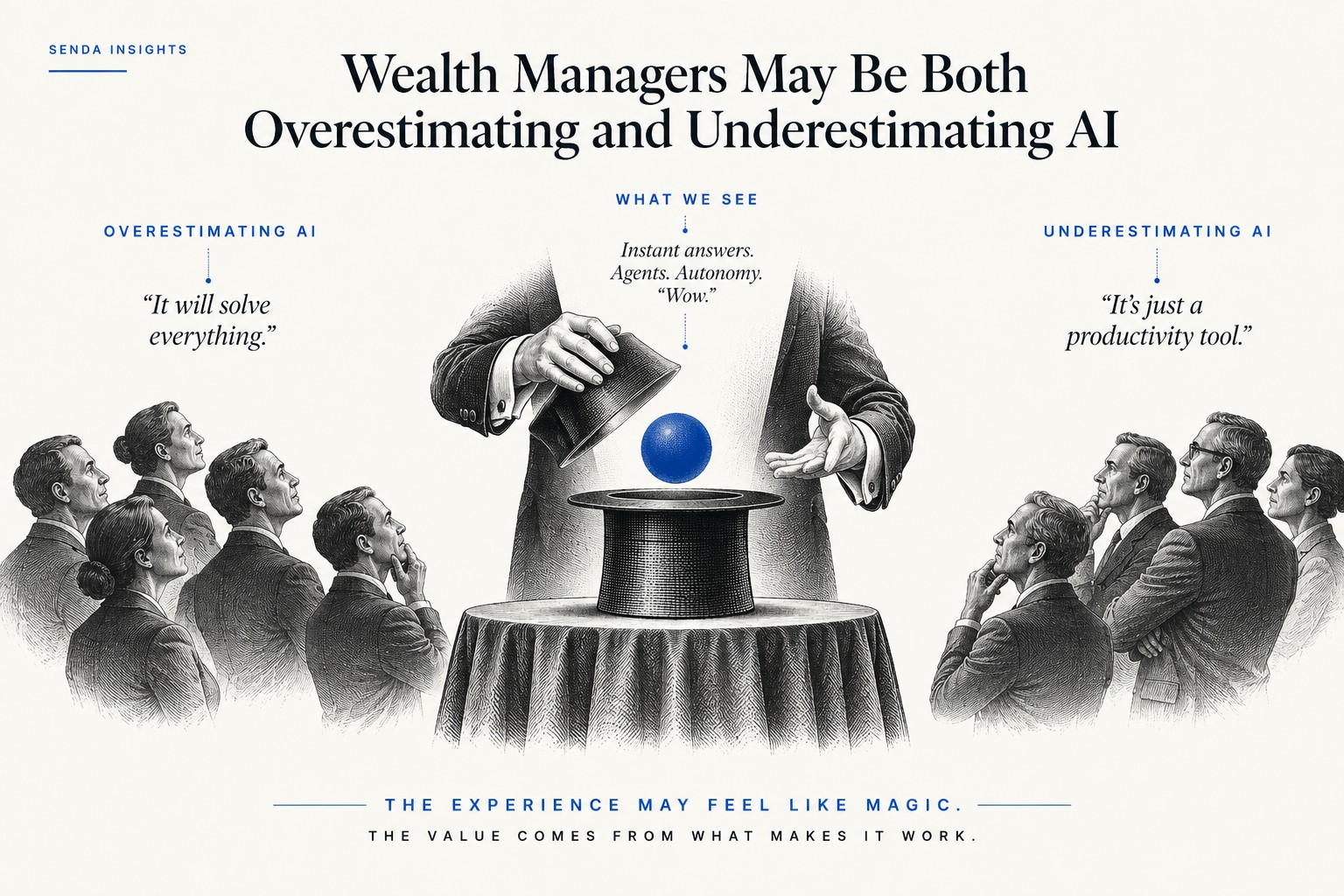
AI is creating a curious paradox in wealth management. The extraordinary capabilities of ChatGPT, Claude and increasingly powerful agents have created an expectation that AI should feel almost magical: ask the right question, connect the right data and the answer should simply emerge. Yet when that expectation encounters the realities of enterprise data, governance and decision-making, institutions can swing to the opposite conclusion, limiting AI to summaries, search and productivity tools. Both reactions may be missing the larger opportunity.
Artificial intelligence has developed an unusual ability to surprise us repeatedly. A new model demonstrates better reasoning, an agent navigates multiple applications, a complex document is understood in seconds, or an investment memo that might once have taken hours appears almost instantly. A user can upload a portfolio, ask a sophisticated question and receive an answer that would have seemed remarkable only a few years ago.
This constant novelty creates a powerful “wow” effect, but it also shapes what people expect AI itself to feel like. The first experience of ChatGPT or Claude can genuinely feel magical. A complicated question is expressed in ordinary language and, seconds later, an intelligent response appears. Almost none of the complexity between question and answer is visible.
Increasingly, that experience is becoming the benchmark against which enterprise AI is judged. If AI is genuinely intelligent, why shouldn't an advisor simply ask it what to do? If a frontier model can already analyse a portfolio or interpret an investment document, why shouldn't a wealth manager eventually connect its systems, provide access to its information and allow the AI to work out the rest?
Yet when institutions try to move from that experience to consequential enterprise work, reality becomes more complicated. Data sits across multiple systems, context is incomplete, permissions matter, calculations must be correct, policies need to be respected, exceptions appear and important decisions require approval. The institution may also need to explain later why a recommendation was made and what information, models and policies contributed to it.
When the apparent magic encounters these realities, some institutions move toward the opposite conclusion. AI becomes useful for meeting summaries, document search, research synthesis, email drafting and employee assistance, but remains largely outside consequential institutional decisions.
Wealth managers may therefore be expecting too much from AI on its own while expecting far too little from what AI can enable the institution to do.”
The Expectation of Magic
Consumer AI has established an unusual expectation for enterprise technology. Historically, sophisticated enterprise systems looked sophisticated. Users could see workflows, calculations, rules, approvals and processes because much of the purpose of the technology was to manage complexity. AI has reversed that experience. Some of the world's most sophisticated technology now presents itself as an almost empty text box, creating the impression that greater intelligence should progressively make the machinery underneath unnecessary.
Consider asking a frontier model to “review this client's portfolio and tell me what we should recommend.” A capable model may produce an impressive response. It can analyse allocations, identify concentrations, interpret market conditions, compare alternatives and suggest potential changes. Given sufficient information, the reasoning may be remarkably sophisticated.
But the phrase “what we should recommend” contains much of the complexity of a wealth-management institution. The appropriate recommendation may depend on the client's complete portfolio and family context, mandate, liquidity requirements, tax circumstances, previous conversations, existing commitments and historical decisions. It may need to incorporate the firm's asset-allocation framework, current house views, approved product universe and product rankings. Policies determine what is permissible, permissions determine what can be accessed, and different recommendations may require different approvals.
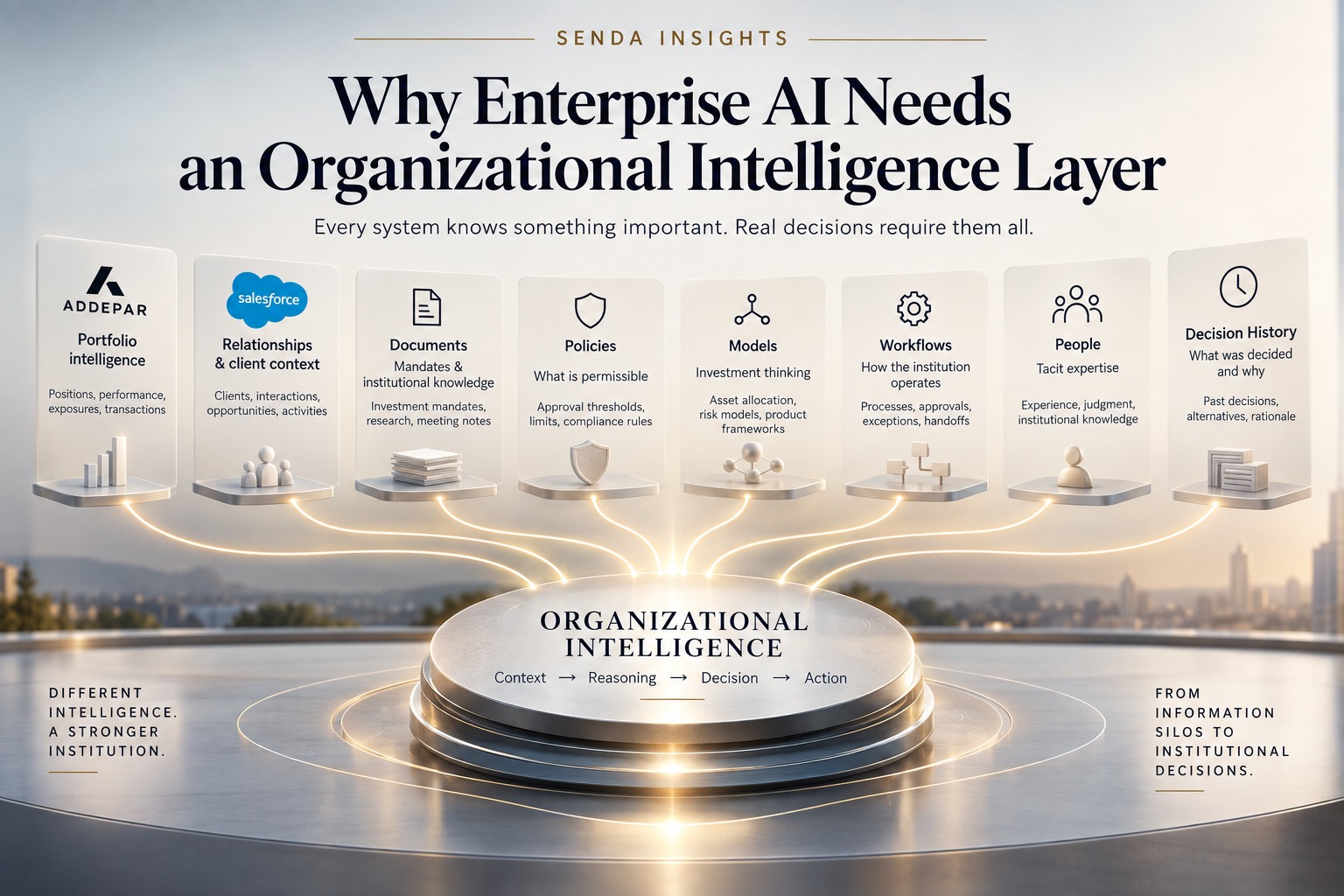
This intelligence is distributed across the institution. Some lives in the CRM, some in portfolio systems and some in documents. Other parts are encoded in analytical models, policies, workflows and previous decisions, while important elements may still reside primarily in the experience of people. A more capable model can reason more effectively over the context it receives, but it does not automatically create the institutional context, controls and operating processes surrounding that reasoning.
The eventual user experience may nevertheless become extraordinarily simple. An advisor might ultimately ask one question and receive a comprehensive institutional response. Underneath that interaction, however, may sit data integration, permissions, institutional knowledge, deterministic calculations, analytical models, policies, workflow orchestration, decision history and human approvals.
Enterprise AI can feel magical to the person using it without depending on magic underneath.”
When the Most Valuable AI Looks Less Magical
This creates an interesting problem when institutions evaluate AI. The characteristics that make a demonstration impressive are not necessarily those that make a system valuable in production. An unconstrained model producing an elegant investment recommendation in seconds creates an immediate “wow.” A governed system showing how it interpreted the mandate, understood the portfolio, applied the asset-allocation methodology, checked constraints, evaluated products and routed the recommendation for approval may appear less novel.
Yet the second system may be doing something far more consequential. For an important financial decision, calculations may need to be reproducible, policies explicit, sources traceable, permissions enforced and approvals recorded. The institution may need to understand why a recommendation was made and reconstruct the decision later. These requirements do not diminish the intelligence of the system; they are what make that intelligence usable by an institution.
The speed of AI development makes this distinction harder because novelty continually resets expectations. A new agent navigating applications or a model producing an investment presentation instantly is highly visible. Some of the highest-value uses of AI in wealth management may be much less dramatic: identifying every client affected by a change in a fund ranking, continuously detecting portfolios requiring attention, recognizing clients with additional investment capacity, or reducing a complex investment proposal process from days to minutes while preserving the institution's methodology and approvals.
AI's novelty is highly visible, while much of its enterprise value is embedded inside ordinary work.”
The most impressive demonstration may therefore not be the most valuable capability. Institutional value emerges when something important can be performed better and more consistently across hundreds or thousands of clients, portfolios and decisions. Novelty attracts attention; repeatability turns intelligence into enterprise value.
General Intelligence Is Not Institutional Intelligence
The expectation of magic also obscures an important distinction between general intelligence and institutional intelligence. Frontier models increasingly possess remarkable general capabilities, but a wealth manager does not make decisions using general intelligence alone. It makes them inside a particular institutional environment containing its clients, investment philosophy, products, policies, governance, historical decisions and accumulated expertise.
An AI model considering whether a client should increase exposure to an asset class may understand that asset class exceptionally well. It can analyse markets, assess risk and construct a sophisticated investment argument. The institutional decision can nevertheless be different. The client's mandate may impose a limit, future liquidity requirements may make the allocation inappropriate, existing commitments may change the analysis, the investment committee may hold a different view, or a particular product may not be approved for that client. An experienced advisor may also know something about the family that is poorly represented in structured data.
The issue is not whether the model is sufficiently intelligent. It is that the decision belongs to the institution rather than to the model.** Some complexity will certainly disappear as AI improves, but much of what surrounds an institutional decision is not accidental complexity waiting for a better model to remove it. It represents the institution's knowledge, investment philosophy, controls and accountability.”
The Opposite Mistake
Recognizing those limitations can, however, push institutions too far in the other direction. AI becomes classified primarily as a productivity technology. Employees receive assistants for drafting emails, summarizing meetings, searching documents and preparing presentations. These applications are useful and can create meaningful efficiencies, but they may capture only a fraction of AI's potential value in wealth management.
Much of the work performed inside a wealth institution is ultimately the production and application of intelligence. Portfolios must be monitored, risks identified, products evaluated, client circumstances understood, investment views interpreted, alternatives compared and recommendations prepared. Relationship managers and investment professionals often spend substantial amounts of time assembling the information required for this work before judgment can even begin.
AI can participate much more deeply without being given unrestricted authority. In an investment proposal, AI can interpret statements and documents, deterministic systems can calculate portfolio characteristics, quantitative models can evaluate allocations and products, policies can constrain permissible recommendations, and workflows can determine how the process proceeds. Human professionals can review alternatives, handle exceptions and approve consequential decisions.
No single AI model needs to perform the entire process autonomously for the overall process to be transformed. Work that once required people to collect information, move between systems, perform analysis and coordinate with specialists can increasingly become a governed process in which much of the required intelligence has already been assembled when human judgment is needed. That represents a considerably larger opportunity than making existing administrative work slightly faster.
Autonomy Is Not the Same as Ambition
The emergence of AI agents has also encouraged institutions to associate sophistication with autonomy. Yet an agent that autonomously schedules meetings, drafts communications and updates records may require almost no human involvement, while an AI system participating in the restructuring of a large family portfolio may require several human approvals. The second has less autonomy but is participating in substantially more consequential work.
In wealth management, human judgment is not simply an inefficiency waiting to be removed. Trust, experience and accountability are part of the value the client receives. The opportunity is therefore not necessarily to remove the professional, but to change where professional time is spent. If AI can continuously monitor portfolios, assemble relevant context, identify emerging issues and evaluate alternatives, human capacity can move away from information assembly and toward judgment. The institution can potentially apply its best expertise across more clients and decisions without increasing organizational complexity at the same rate.
From Wow to Institutional Value
The more useful question for wealth managers may not be what the latest AI model can do, but what the institution can now do differently because AI exists.”
This changes the unit of analysis from the model to the decision and from the demonstration to the operating model.
Does AI improve the quality or consistency of an important decision? Does it allow expertise to reach more clients? Does it identify risks or opportunities that would otherwise be missed? Does it materially reduce the time required to perform consequential work? Does it allow clients, assets and revenues to grow without organizational complexity increasing at the same rate? And can the resulting decisions remain explainable, governable and consistent with the institution's responsibilities?
Once AI is evaluated this way, there is less reason to ask one technology to do everything. Language models can reason where reasoning is useful, deterministic systems can calculate where precision matters, analytical models can provide specialized intelligence, policies can establish boundaries, workflows can orchestrate actions and people can remain accountable where judgment matters. Somewhat paradoxically, giving AI itself less responsibility can allow the institution to use AI for much more important work.
The Opportunity Between the Extremes
Wealth managers therefore face two tempting but incomplete visions of AI. One imagines that increasingly powerful models will eventually make institutional complexity disappear: connect the data, ask the question and allow the intelligence to take care of everything in between. The continuous novelty of frontier AI makes this future feel increasingly plausible. The other encounters the limitations of that approach and concludes that AI's practical role is primarily as an assistant around the edges of the existing operating model.
The larger opportunity sits between those extremes. AI can read information humans cannot continuously read, monitor portfolios at a scale humans cannot continuously monitor, identify relationships across institutional information, assemble context on demand, evaluate alternatives and initiate governed workflows. It can make institutional knowledge available when it is needed and allow scarce human expertise to influence substantially more decisions.
The institution still provides what the AI does not. Its data establishes facts, its models provide analytical discipline, its policies establish boundaries, its workflows determine how decisions move, its permissions control access, its history provides memory, and its people provide judgment and accountability. These are not limitations on the ambition of AI; they are what allow increasingly powerful AI to participate in increasingly important work.
The wealth-management industry may therefore be overestimating and underestimating AI at precisely the same time. The novelty and apparent magic of frontier AI can lead institutions to expect too much from the model. When that magic encounters enterprise reality, disappointment can lead them to expect too little from AI altogether. The better path may be to preserve the simplicity and intelligence that make AI so compelling for the user while deliberately engineering the institutional machinery required underneath it.
Enterprise AI may eventually feel almost magical. But the institutions that derive the most value from it are likely to be those that understand exactly how the magic works.”
Senda Editorial Team
Research & Insights