What Happens When Every Client Portfolio Can Be Monitored Every Day?
For decades, wealth management has relied on periodic portfolio reviews, advisor attention and event-driven intervention. AI is creating the possibility of a different model: one in which every client portfolio can be continuously assessed, emerging risks and opportunities identified systematically, and advisors directed toward the clients who need them most. The implications may extend beyond efficiency, changing how wealth managers deliver advice, distribute expertise and scale their businesses.
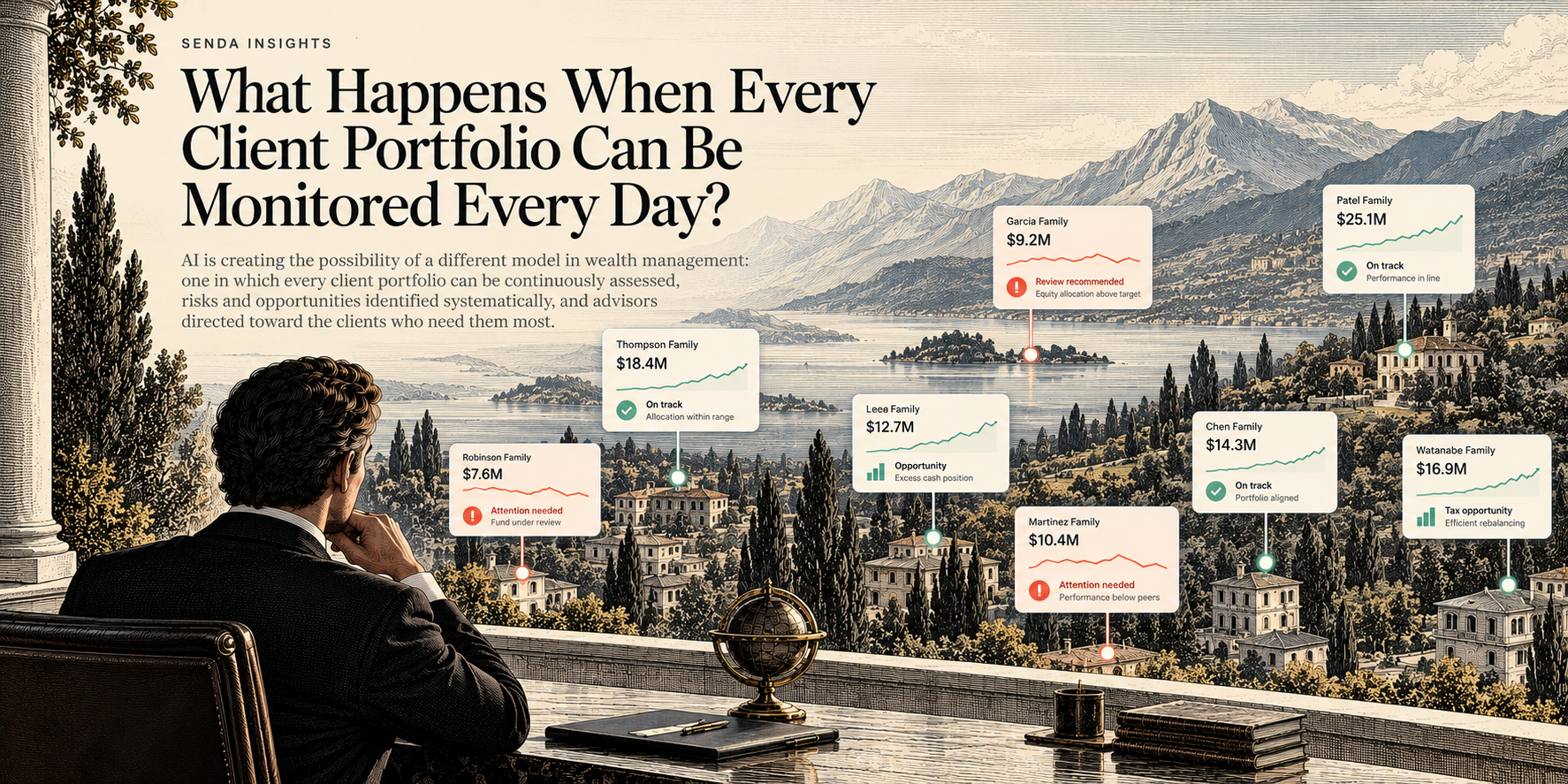
For decades, wealth management has relied on periodic portfolio reviews, advisor attention and event-driven intervention. AI is creating the possibility of a different model: one in which every client portfolio can be continuously assessed, emerging risks and opportunities identified systematically, and advisors directed toward the clients who need them most. The implications may extend beyond efficiency, changing how wealth managers deliver advice, distribute expertise and scale their businesses.
Wealth management has always faced a fundamental constraint. An institution may serve thousands of clients, but the number of portfolios it can examine in depth at any given moment is limited by the time and expertise available.
Relationship managers balance client meetings, portfolio reviews, investment recommendations and ongoing service. Investment teams provide research and guidance, while technology systems generate reports, calculate performance and monitor selected risks. Much of the institution's attention is therefore organized around review calendars, client requests and events that trigger intervention.
This model has served the industry for decades. But it creates an important limitation: the depth and frequency of portfolio attention depend partly on the institution's available human capacity, rather than solely on what each client needs. A portfolio may drift away from its intended allocation between reviews. An investment may begin underperforming its peers. A change in research may affect several hundred clients, yet translating that development into individual portfolio implications can take considerable time.
The institution may possess the information required to identify these developments without having the capacity to examine every client portfolio continuously. AI may begin to change that equation.
From Periodic Reviews to Continuous Intelligence
Consider a wealth manager serving 1,000 client families, each with different investment objectives, risk preferences, liquidity requirements and portfolio structures. What if the institution could systematically assess every portfolio each day against its investment mandate, asset allocation, performance, concentration risks and relevant investment views?
It could identify clients whose allocations have moved outside intended ranges, investments showing persistent underperformance, unusual cash positions or changes in research that affect existing holdings. Instead of waiting for the next scheduled review, advisors could be informed when something meaningful requires attention.
This would not necessarily mean generating daily recommendations or encouraging more transactions. An allocation deviation may be temporary and acceptable. An underperforming fund may still be appropriate for a particular client. A large cash position may reflect an upcoming liquidity requirement rather than an investment opportunity. The purpose would be to distinguish between developments worth observing, issues requiring investigation and circumstances that justify a client conversation.
The institution would move from periodically examining portfolios to continuously understanding which portfolios need attention.”
That is more than an improvement in reporting frequency. It represents a potential change in how the institution organizes its advisory activity.
The Difference Between Portfolio Data and Client Intelligence
Most wealth managers already possess substantial amounts of portfolio data. Portfolio systems track holdings and transactions. Research teams evaluate investment products. CRMs contain relationship information. Investment mandates define objectives and constraints. The challenge is that the information required to make a useful decision is often distributed across these systems, documents and people.
A fund may be underperforming, but replacing it may not be appropriate. A concentrated position may reflect a deliberate client preference. An allocation outside its target range may have been temporarily approved. An attractive investment opportunity may conflict with a client's liquidity needs or investment restrictions. Meaningful intelligence must therefore connect portfolio analytics with client objectives, investment mandates, institutional research, policies and advisor knowledge.
Consider an investment committee changing its assessment of a fund because of persistent underperformance or a change in investment strategy. The research conclusion is only the beginning. The institution must determine which clients hold the fund, how significant their exposures are, whether alternatives are suitable and which relationships warrant priority attention. Today, translating that decision into client-specific action may require substantial coordination between investment teams and relationship managers.
With connected intelligence, the institution could systematically identify affected portfolios, evaluate the relevance of the research change and bring the appropriate analysis to each advisor.
Investment research would no longer remain simply an institutional recommendation. It could become continuously available client-specific intelligence.”
Human judgment would remain essential, but advisors would begin with a richer understanding of where their attention is needed and why.
From Identifying Risks to Recognizing Opportunities
Continuous portfolio intelligence should not be limited to identifying problems. A wealth manager's responsibility also includes recognizing opportunities to improve a client's financial position. A portfolio may hold excess cash, an investment may have matured, an asset allocation may no longer reflect the client's objectives or a revised investment view may create an opportunity to improve diversification.
In traditional operating models, recognizing these opportunities often depends on the initiative, knowledge and available time of individual advisors. Systematic intelligence could make opportunity identification more consistent across the client base. However, identifying an opportunity is not the same as recommending an action. A meaningful recommendation must consider the client's investment objectives, risk capacity, liquidity needs, tax implications, existing exposures and applicable restrictions.
This distinction matters because the value of AI should not be measured by the number of recommendations it generates. More recommendations do not necessarily produce better advice. The opportunity is to help institutions recognize where professional attention could create value, provide the analysis required to evaluate the situation and allow advisors to exercise informed judgment.
Better intelligence should improve the quality of decisions, not simply increase the volume of activity.”
Changing the Economics of Advisor Capacity
A relationship manager's capacity is constrained by more than the time spent meeting clients. Considerable effort goes into preparing for those meetings, assembling portfolio information, reviewing performance, identifying concerns, evaluating investment alternatives and coordinating with research teams.
Some of this work requires relationship knowledge and professional judgment. Other parts involve gathering information, applying established analytical methods, checking policies and assembling the context required for a decision. If institutions can perform more of this preparatory work systematically, advisors can devote greater attention to interpretation, judgment, client communication and action.
This creates opportunities for both deeper service and greater capacity. Existing clients could receive more proactive and consistent attention because the institution is better able to identify when something warrants review. Advisors may also be able to serve larger or more complex client books without a proportionate increase in analytical and administrative effort.
Neither outcome is automatic. Poorly designed monitoAI may allow wealth managersring could overwhelm advisors with alerts, while unreliable recommendations could undermine confidence. The intelligence must be accurate, relevant, trusted and integrated into everyday workflows. But if implemented effectively, the implications extend beyond reducing the cost of individual tasks.
AI could begin changing the relationship between the number of clients an institution serves and the human effort required to serve them well.”
For wealth managers seeking to grow without a corresponding increase in organizational complexity, that may become one of AI's more consequential applications.
Extending Institutional Attention Across the Client Base
Historically, the depth of personalized attention has often increased with the economic value or complexity of the client relationship. Larger clients may receive more frequent reviews, dedicated investment expertise and extensive portfolio analysis. Smaller relationships may receive a more standardized service model. This reflects the economics of scarce professional capacity.
If sophisticated portfolio monitoring becomes substantially less expensive to deliver, however, the economics of analytical attention may change. An institution could apply the same underlying monitoring discipline across a broader proportion of its client base while continuing to differentiate the level of human engagement appropriate to each relationship.
A client with a relatively modest portfolio may not require the same advisory structure as an ultra-high-net-worth family. But the institution could still identify meaningful allocation drift, unusual concentration, deteriorating investment characteristics or a mismatch with stated objectives. The distinction is between standardizing the quality of analytical oversight and standardizing advice itself.
AI may allow wealth managers to extend institutional investment intelligence to more clients without treating every client as though their circumstances are identical.”
This could become an important source of competitive differentiation, particularly for institutions seeking to combine high-quality advice with greater scale.
From Individual Portfolios to Institutional Intelligence
The opportunity becomes more significant when intelligence extends beyond individual portfolios. A wealth manager does not simply manage thousands of independent accounts. It manages an interconnected book of client relationships, investment exposures, research views, product decisions and advisory responsibilities.
When these dimensions can be assessed together, management gains a different perspective on the institution. It can understand which investment concerns affect the largest number of clients, where portfolio risks are concentrated, which research changes have the broadest client implications, which advisors have the greatest number of unresolved portfolio issues and where investment expertise is being applied inconsistently.
These are not merely portfolio questions. They are questions about how the institution operates. The ability to answer them systematically could improve investment governance, management visibility, advisor support and the allocation of organizational resources.
Over time, the decisions advisors make, the recommendations they approve or reject and the reasons behind those choices could also contribute to institutional knowledge. The institution could begin understanding not only what happened in client portfolios, but why particular decisions were made. That creates the possibility of a more connected investment and advisory organization, where knowledge generated in one part of the institution becomes useful elsewhere without compromising client confidentiality or individual mandates.
A Different Model of Wealth Management
Continuous intelligence does not mean continuous trading. Markets fluctuate, investment views evolve and not every deviation warrants intervention. Excessive activity can introduce transaction costs, tax consequences and unnecessary client anxiety. A reliable system must distinguish between observations and actionable issues, respect investment mandates, apply institutional policies and preserve appropriate human oversight.
The objective is not to replace professional judgment. It is to make that judgment better informed, more consistent and available where it matters most.
For decades, wealth managers have organized much of their operating model around how many portfolios their people could meaningfully review. AI creates the possibility of organizing it around which portfolios actually need attention. The implications extend to how proactively institutions identify client needs, how consistently investment expertise is distributed, how effectively advisors use their time and how wealth managers scale without compromising service quality.
The future of wealth management may therefore not be one in which every client receives more frequent reports. It may be one in which every client benefits from an institution that is continuously paying attention.”
Senda Editorial Team
Research & Insights