The Most Valuable AI Asset Isn't the Model
As AI models become commodities, institutional intelligence becomes the new strategic moat.
Earlier this year, Palantir CEO Alex Karp made an observation that caught my attention.
As enterprises rush to adopt artificial intelligence, he argued, many risk giving away the very thing that makes them unique. The real value of an organization does not lie in access to the latest AI model. It lies in the knowledge, experience and judgement accumulated over decades of operating its business.
Whether one agrees entirely with his perspective is almost beside the point. It raises a much bigger question.
As foundation models become increasingly powerful and widely available, what exactly remains proprietary?
For much of the past two years, enterprise AI conversations have revolved around a familiar question. Which model should we use?
Should we build on OpenAI? Anthropic? Gemini? An open-source model? Should we host it ourselves or consume it as a service?
These are important architectural decisions, but I increasingly believe they are not the most important strategic ones.
A different question is beginning to emerge. How can an enterprise leverage the world's most advanced AI models without giving away its own institutional intelligence?
For financial institutions, this question is particularly significant.
Imagine one of the world's leading wealth managers. Over decades, the organization develops a distinctive investment philosophy. It builds proprietary research, market views, portfolio construction methodologies, risk frameworks, product selection processes and governance models. Advisors accumulate deep relationships with clients across multiple generations. Investment committees debate thousands of decisions. Analysts refine their thinking through countless market cycles.
None of this institutional intelligence exists inside a foundation model. It exists inside the enterprise.
Foundation models may provide intelligence at scale, but they cannot replicate the decades of experience, judgment and institutional knowledge that make an enterprise truly unique. Those assets remain the organization's greatest source of competitive advantage.”
In many ways, these assets are the business.
Technology platforms can be replaced. Foundation models will continue to evolve. Even investment products eventually become commoditized.
Institutional intelligence is much harder to replicate. It represents thousands of decisions, millions of interactions and decades of accumulated learning.
Yet much of today's discussion around Enterprise AI focuses almost entirely on the model. This may prove to be a mistake.
History suggests that foundational technologies eventually become widely available. Cloud computing followed this path. Databases followed this path. The internet itself became universal infrastructure rather than a competitive advantage.
Foundation models appear to be moving in the same direction. Every few months, another generation arrives with improved reasoning, larger context windows, faster inference and lower costs. Organizations can increasingly choose between multiple frontier models, switch providers or deploy open-source alternatives.
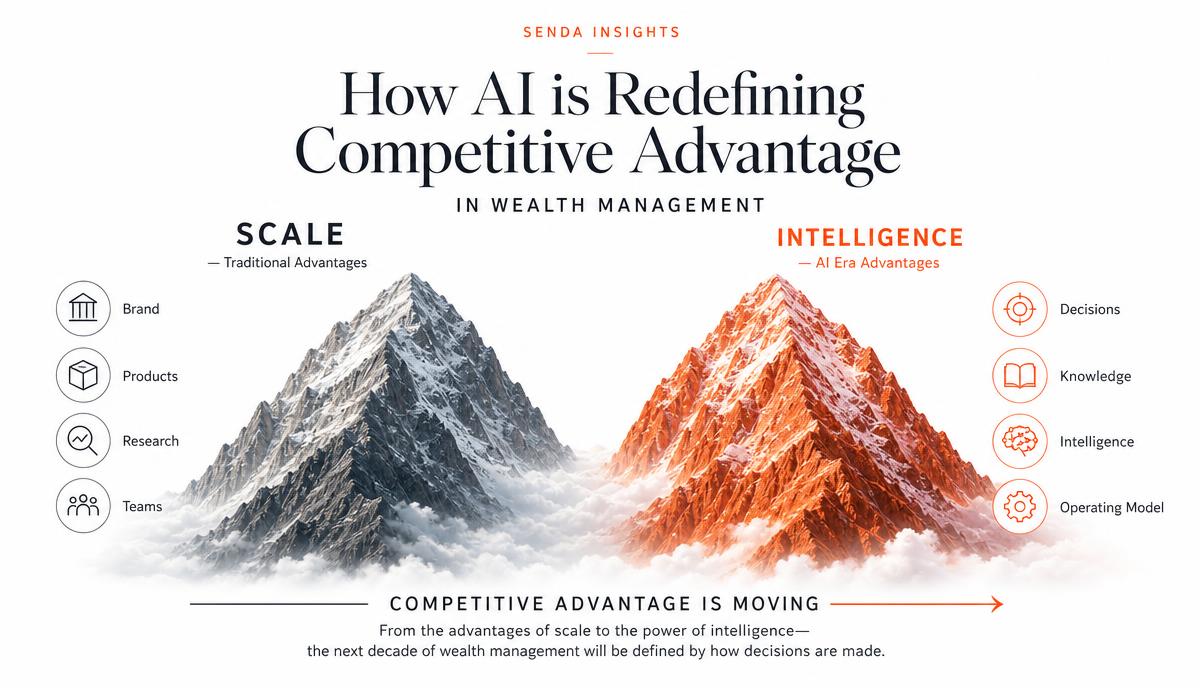
If access to intelligence becomes widely available, then competitive advantage must come from somewhere else. It is unlikely to come from simply owning the latest model.
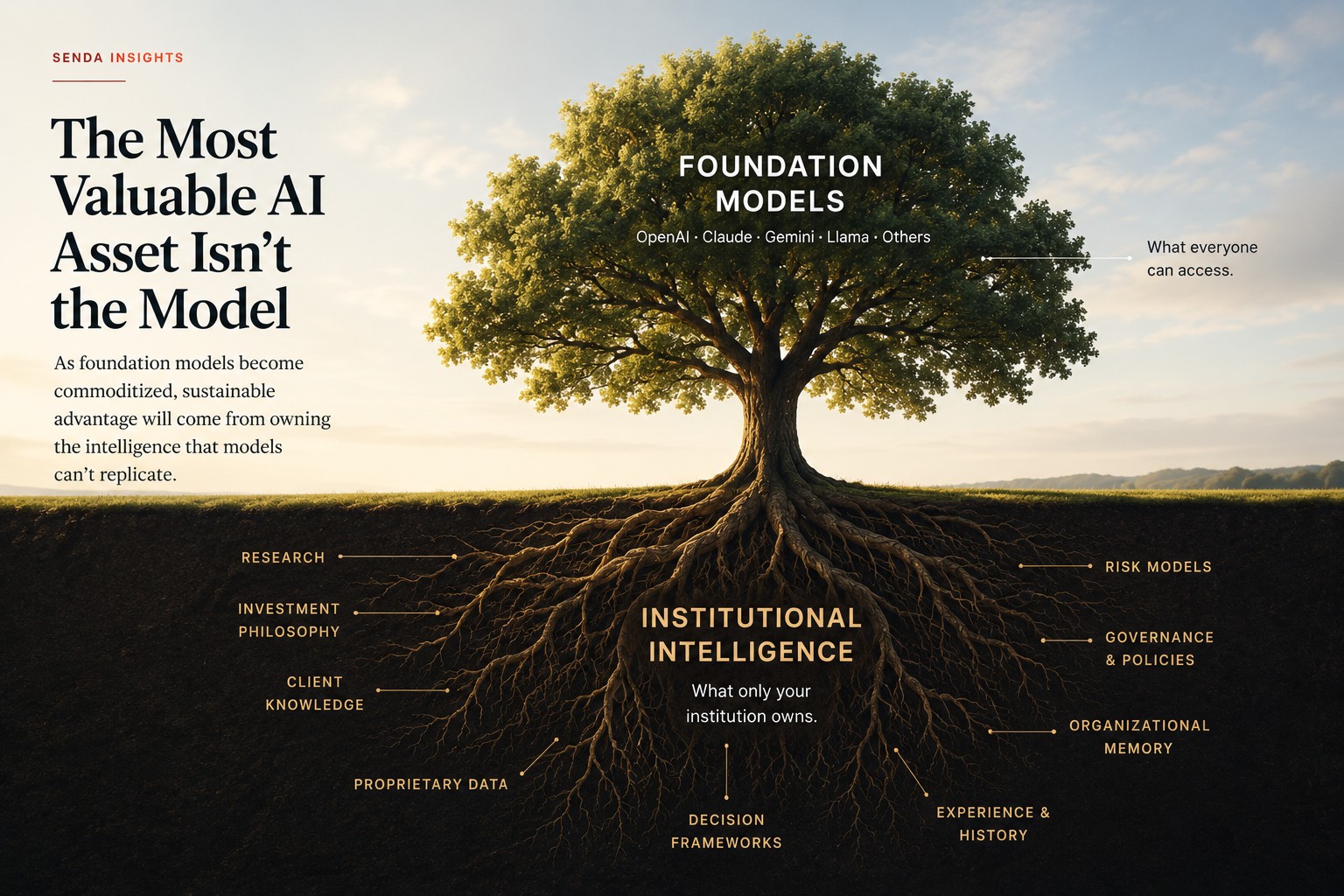
When every enterprise can access world-class AI models, competitive advantage no longer comes from the model itself. It comes from the proprietary intelligence, governance and decision-making capabilities that surround it.”
Instead, it may come from owning everything that surrounds the model. The institutional knowledge that defines how an organization thinks. The accumulated experience captured across thousands of decisions. The proprietary methodologies that cannot be downloaded from the internet. The governance frameworks that determine how judgement is exercised. The organizational memory that compounds over time.
These assets become increasingly valuable precisely because foundation models are becoming increasingly common.
This also changes how we should think about Enterprise AI architecture.
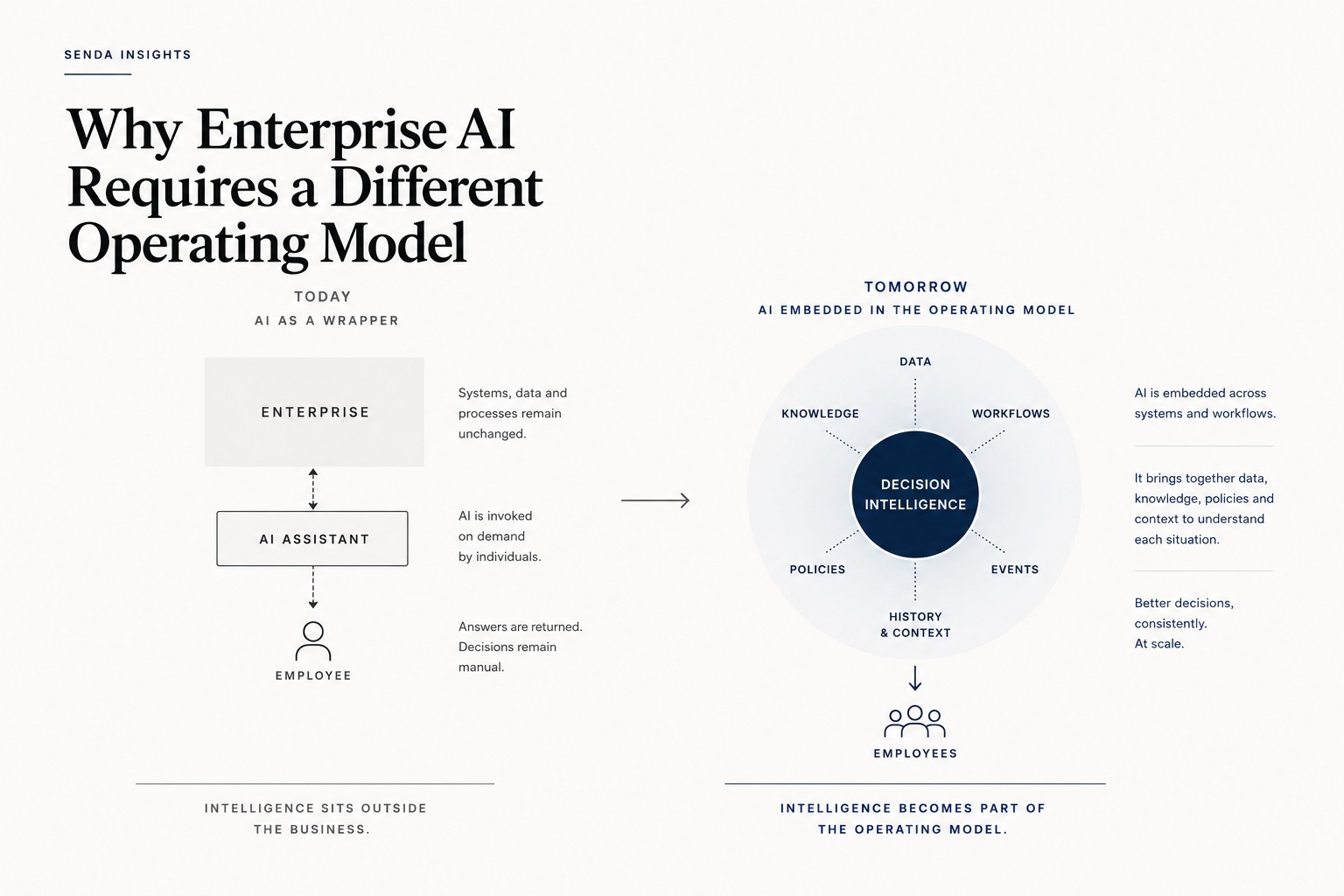
For years, organizations have viewed AI primarily as an external capability. A model answers questions, summarizes documents or generates content. Employees decide when to invoke it and how to use the results.
But if intelligence becomes part of the operating model itself, the architecture must evolve beyond simply connecting users to models.
Enterprises will increasingly need to think about four very different layers.
The first is data—the information owned and governed by the institution. The second is models—the foundation models that continue to improve at remarkable speed. The third is institutional intelligence—the organization's proprietary research, knowledge, experience, methodologies, relationships and accumulated learning. The fourth is decision infrastructure—the policies, quantitative models, governance, approvals and reasoning that determine how important decisions are ultimately made.
These layers are often discussed as though they are one. They are not.
Foundation models should continue to evolve independently. Organizations should remain free to adopt whichever model is most capable tomorrow without rebuilding everything they created yesterday.
Institutional intelligence, however, should remain entirely their own. It should continue to learn from every decision, every client interaction, every market event and every business outcome.
The enterprises that create lasting value in the AI era will not be those with exclusive access to better models, but those that continuously capture, protect and compound their own institutional intelligence.”
Perhaps this is where Enterprise AI is heading. Not toward organizations that own the largest models, but toward organizations that own the richest institutional intelligence.
The model may become a utility. Institutional intelligence will not.
As frontier AI continues to advance, I suspect the conversation inside boardrooms will gradually shift. The question will no longer be, "Which model should we use?"
It will become something far more strategic. "How do we ensure that, as AI becomes more capable every year, the intelligence that truly differentiates our institution remains entirely our own?"
That may ultimately prove to be one of the defining strategic questions of the AI era.
Senda Editorial Team
Research & Insights