AI Is Changing What Trust Means in Wealth Management
As wealth managers introduce AI into advice and client service, clients are asking new questions about data, decisions and accountability. The answers may redefine what trust means in wealth management.
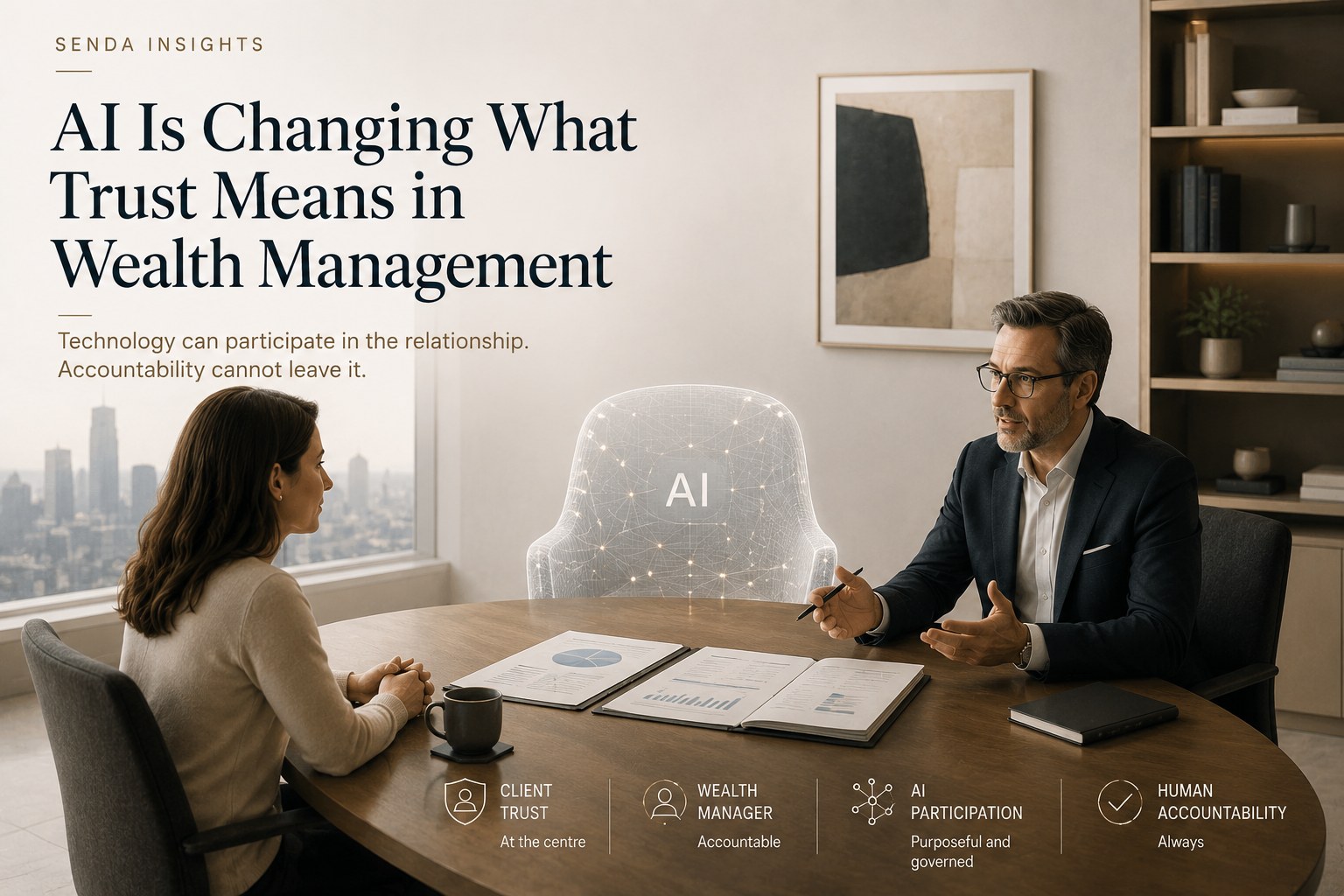
As wealth managers introduce AI into advice and client service, clients are beginning to ask a new set of questions: where does my information go, what does AI learn from it, who controls the decision and who remains accountable? Regulation is increasingly asking many of the same questions. The answers may redefine what trust means in wealth management.
A wealth-management client recently asked a deceptively simple question:
If AI is helping you advise me, what happens to my financial and personal information—and how do I know it isn't being used to train an AI model or benefit another client?”
It is the kind of question wealth managers should expect to hear much more often.
For decades, the industry's trust architecture was relatively well understood. Clients entrusted institutions and advisors with highly sensitive information: their assets, liabilities, family circumstances, businesses, investment preferences and sometimes deeply personal financial decisions. They expected that information to remain confidential, secure and used for the purpose for which it was provided.
AI introduces another dimension.
Where does the information go? Which models can see it? What do those models retain? Can information from one client influence another? Is AI making the recommendation or assisting the advisor? Can the institution explain how a recommendation was reached? And if something goes wrong, who is accountable?
AI is not reducing the importance of trust in wealth management. It is expanding what clients expect trust to mean.”
Privacy Is Becoming a Question of Use, Not Just Protection
For years, information security focused heavily on where data was stored, who could access it and how it was protected. Those questions remain essential. But AI introduces a different one:
What is the information being used for once a machine can learn, infer and generate from it?
Imagine an advisor preparing for a client meeting. The advisor has access to a powerful general-purpose AI tool and pastes in a portfolio statement, family details and notes from previous conversations to generate an analysis.
The immediate productivity gain is obvious. But the institutional questions are considerably more complicated.
Has personally identifiable information left the institution's controlled environment? What contractual terms govern how the external model provider processes it? Is information retained? Could it be used for model improvement? In which jurisdiction is it processed? Who can subsequently access it? Can the institution reconstruct what information was sent and what the model returned?
Increasingly, these cannot be left to individual employee judgment.
A wealth manager may therefore decide that employees cannot simply paste identifiable client information into a general-purpose frontier model, even where the model itself is highly capable. Instead, approved AI systems may need controlled interfaces, data minimization, permissions, masking or anonymization, logging and contractual safeguards around external providers.
That is not necessarily because a regulator has issued a rule saying, "Do not use frontier models." It is because existing obligations around privacy, security, outsourcing, governance and customer protection continue to apply when AI is introduced—and regulators are making that increasingly explicit.
Regulators Are Asking Similar Questions
The regulatory direction across major financial markets is notable.
Switzerland's FINMA has identified data security, explainability, robustness, bias and growing dependency on third-party model and technology providers among the risks institutions need to manage when deploying AI. Its supervisory expectation is that institutions understand how AI changes their risk profile and adapt governance and controls accordingly.
The UK's FCA has taken a deliberately technology-neutral approach rather than creating a separate AI rulebook. Existing requirements around Consumer Duty, governance and senior-management accountability continue to apply. More revealingly, industry participants responding to the FCA's AI work highlighted difficulties assessing data privacy, conduct and third-party risk when external AI providers cannot sufficiently explain their models, training data, biases or limitations.
The direction of third-party regulation is also tightening. The UK has introduced direct oversight of designated critical technology providers while explicitly maintaining that financial firms themselves remain responsible for managing their third-party risks.
India is moving in a similar direction. The Reserve Bank of India's work on responsible and ethical AI has highlighted data privacy, explainability and algorithmic bias as risks that should be addressed early in AI adoption. RBI has also emphasized that financial institutions, as custodians of sensitive customer information, require robust data-governance frameworks covering both themselves and their data processors.
The frameworks differ. Their implications increasingly converge.
Using somebody else's model does not mean outsourcing responsibility for what happens to the client's information or the resulting decision.
That principle could materially change how AI is deployed inside wealth-management firms.
From Data Sovereignty to Decision Sovereignty
Protecting client data, however, is only the beginning. AI can derive intelligence from information.
A client's portfolio, transaction history, family circumstances, preferences and previous decisions can collectively produce something more valuable than the underlying records: an increasingly sophisticated understanding of that client.
Who owns that intelligence?
Should intelligence derived from one client ever improve recommendations for another? What happens when proprietary investment research, house views or portfolio methodologies interact with an external model? How does an institution prevent its accumulated intellectual capital from gradually becoming dependent upon technology it does not control?
These questions suggest that wealth managers may need to think about AI sovereignty across four dimensions.
Data sovereignty asks who controls the underlying client and institutional data.
Model sovereignty asks whether the institution can determine which models are used, under what conditions, and replace them as technology evolves.
Intelligence sovereignty asks who owns and controls the knowledge derived from client information, research, investment philosophy and institutional experience.
And decision sovereignty asks who ultimately controls how consequential decisions are made—including policies, quantitative methodologies, permissions, human approvals and permitted actions.
This last distinction may prove particularly important. AI models can contribute enormous value to a decision process without becoming the system of control for that process.
Clients Will Eventually Ask: Who Made the Decision?
The question becomes more consequential as AI moves from summarizing information to influencing advice.
A client may have little interest in how AI summarized a research report. The standard changes when AI contributes to a recommendation to sell an investment, change an asset allocation, rebalance a portfolio or alter the client's financial strategy.
Then a simple question becomes unavoidable: Why are you recommending this to me?
"The model suggested it" is unlikely to be an adequate institutional answer.
A wealth manager should be able to understand the information considered, the policies applied, the analysis performed, the alternatives evaluated, where AI contributed, where human judgment intervened and who ultimately approved the action.
This is where explainability becomes more than a technical characteristic of a model. It becomes part of the client relationship.
And the same is true of accountability. Wealth managers will use increasingly complex ecosystems of foundation models, specialized models, quantitative systems, data providers and technology platforms. Clients should not have to understand that technology supply chain to know who is responsible for the advice they receive.
From their perspective, the answer remains remarkably simple: You are my wealth manager.
Technology can be outsourced. Accountability cannot.”
Trust May Become an Architectural Property
This creates an important strategic choice for the industry.
One response is to restrict AI so severely that little meaningful client information can interact with it. That may protect against certain risks, but it also sacrifices much of AI's potential to improve advice, personalization and service.
The opposite approach—allowing information to flow freely into powerful models because those models produce better answers—creates a different set of risks.
The more promising path lies between the two.
Institutions can design architectures in which AI receives the information necessary for a specific task without automatically receiving everything the institution knows about the client. Different models can be permitted for different purposes. Personally identifiable information can be separated where it is unnecessary. Access can be policy-controlled. Decisions can incorporate deterministic rules and quantitative models alongside AI. Human approvals can remain where judgment or regulation requires them. Material actions can be traced and reconstructed.
In such an environment, governance is not something applied to AI after it has produced an answer. It becomes part of how the AI is allowed to operate.
That may become increasingly important as regulators, boards and clients ask essentially the same question from different perspectives: Who remains in control?
Wealth management has always been built on trust. AI does not change that foundation. But it expands what institutions must be able to demonstrate to earn it.
Clients will increasingly expect their wealth managers to protect not only their data, but the intelligence derived from it; to understand not only what an AI system recommends, but why; and to remain accountable regardless of which models or technology providers participate in the process.
The institutions that respond by avoiding AI risk sacrificing much of its potential. Those that deploy it without answering these questions risk something considerably more valuable.
The opportunity is to embrace AI without asking clients to surrender control as the price of receiving its benefits.”
That may become one of the defining standards of trust in the next generation of wealth management.
Senda Editorial Team
Research & Insights